
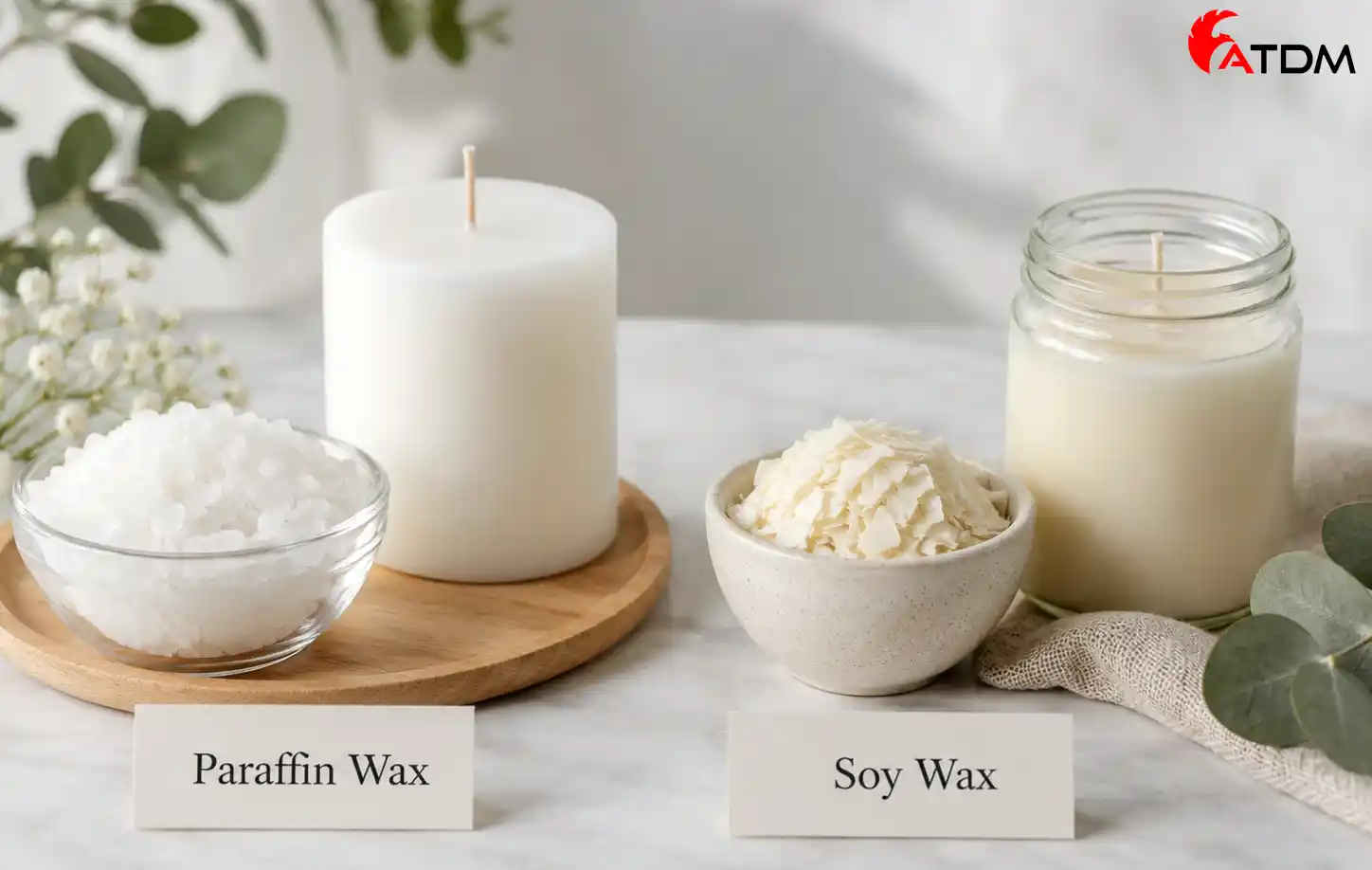
When buyers compare paraffin wax vs soy wax, they usually want a clear answer about performance, cost, scent throw, burn quality, sustainability, and product results. Both waxes serve different markets, and each option brings strong advantages. Therefore, the best choice depends on your final product, budget, target customer, and required quality.
Paraffin wax leads many commercial applications because it offers reliable performance, strong consistency, and excellent versatility. Candle makers, packaging companies, cosmetics brands, rubber manufacturers, and industrial producers choose paraffin wax because it melts smoothly, blends easily, and delivers predictable results. Moreover, trusted suppliers such as ATDM provide paraffin wax for businesses that need stable quality, suitable grades, and bulk supply options.
Soy wax, on the other hand, attracts candle makers who want a plant-based wax with a softer image. Many small candle brands use soy wax for natural-style candles, eco-conscious branding, and clean-label marketing. However, soy wax also has limits, especially in scent strength, hardness, storage stability, and heat resistance. As a result, many manufacturers still choose paraffin wax when they need stronger fragrance performance, brighter color, and better structural control.
Paraffin Wax vs Soy Wax for Candle Making
In candle production, paraffin wax vs soy wax for candles remains one of the most searched comparisons. Paraffin wax usually gives a stronger hot throw and cold throw. In simple terms, it holds fragrance well and releases scent quickly after lighting. Therefore, scented candle brands often prefer paraffin wax when they want bold perfume, luxury aroma, and powerful room coverage.
Soy wax burns more slowly in many candle formulas. Because of this, customers often connect soy wax candles with longer burn time. However, burn time depends on wick size, fragrance load, jar shape, additives, and wax blend. So, soy wax does not automatically outperform paraffin wax in every candle.
Paraffin wax also accepts dye better. It creates bright, sharp, and attractive candle colors. Meanwhile, soy wax often gives softer or muted shades. For brands that sell colorful candles, decorative candles, pillar candles, tealights, birthday candles, and wax melts, paraffin wax can offer better visual results.
Soy Wax vs Paraffin Wax Burn Quality
Many people search for soy wax vs paraffin wax burn quality because they want a clean and pleasant candle experience. A well-made candle depends more on proper formulation than wax type alone. For example, a correctly wicked paraffin candle can burn evenly and smoothly. Likewise, a poorly designed soy candle can tunnel, smoke, or waste wax.
Therefore, manufacturers must test the wick, vessel, fragrance oil, wax melting point, and cooling process. Paraffin wax gives formulators more flexibility because it works with many additives and fragrance systems. Additionally, it supports different candle types, including container candles, pillar candles, votives, taper candles, and wax melts.
Soy wax usually performs best in container candles because it has a softer texture. It can struggle in free-standing candles unless the maker blends it with harder waxes or additives. Consequently, paraffin wax remains a stronger option for producers who need shape stability and wide product variety.
Paraffin Wax vs Soy Wax Cost
Cost strongly affects wax selection. In the paraffin wax vs soy wax price comparison, paraffin wax often gives better value for large-scale production. It usually costs less than soy wax and allows manufacturers to control expenses without reducing product performance. This advantage matters for candle factories, industrial users, packaging producers, and exporters.
Soy wax can cost more because agricultural supply, processing, transportation, and market demand affect its price. In addition, soy wax may require extra testing or blending to achieve the same scent throw, color quality, or hardness. Therefore, businesses must calculate total production cost, not only raw wax price.
For companies that need competitive pricing and steady supply, ATDM as a paraffin wax supplier can support bulk purchasing needs. With the right supplier, buyers can choose suitable paraffin wax grades for candles, cosmetics, coating, rubber, PVC, and other applications.
Scent Throw: Paraffin Wax vs Soy Wax
Fragrance performance creates a major difference between these two waxes. Paraffin wax usually delivers stronger scent throw because it bonds well with fragrance oils and releases aroma efficiently. This feature helps candle brands create premium scented candles with rich, noticeable fragrance.
Soy wax can still carry fragrance, but it often needs careful formulation. Some fragrance oils perform well in soy wax, while others produce weak results. Because of this, soy candle makers test many fragrance loads, wick types, and curing times before final production.
For customers who want powerful scents, paraffin wax candles often feel more satisfying. Meanwhile, soy wax candles may appeal to buyers who prefer softer fragrance and natural-positioned products.
Appearance, Texture, and Finish
Paraffin wax creates a smooth, glossy, and polished finish. It also resists frosting better than soy wax. This makes it suitable for luxury candles, decorative wax products, coated paper, crayons, polishes, and beauty formulas.
Soy wax often develops frosting, rough tops, wet spots, or texture changes. Although these issues do not always harm performance, they can affect product appearance. As a result, brands that focus on premium packaging and flawless surfaces may prefer paraffin wax or paraffin-based blends.
Sustainability and Customer Perception
Soy wax benefits from its plant-based origin, so many buyers connect it with natural candles and eco-friendly products. This perception helps brands that market handmade candles, vegan candles, and sustainable home fragrance.
However, sustainability involves more than raw material origin. It also includes land use, farming practices, transport distance, processing energy, packaging, product waste, and supply chain efficiency. Therefore, businesses should avoid simple claims and instead focus on honest labeling and responsible sourcing.
Paraffin wax remains popular because it uses an existing industrial stream and supports many essential applications. Furthermore, high-quality suppliers help manufacturers reduce waste by delivering consistent wax that performs correctly from the first batch.
Best Uses for Paraffin Wax and Soy Wax
Paraffin wax works best for strong scented candles, pillar candles, votives, tealights, wax melts, waterproof coatings, cosmetics, packaging, rubber, polishes, and industrial blends. It gives strength, stability, scent power, color brightness, and cost efficiency.
Soy wax works best for container candles, handmade candle lines, natural-style branding, soft fragrance products, and customers who prefer vegetable wax candles. It offers a slower-burn image and supports eco-focused marketing.
Final Comparison: Paraffin Wax vs Soy Wax
The paraffin wax vs soy wax decision depends on performance goals. Choose paraffin wax when you need strong scent throw, smooth finish, bright colors, lower cost, reliable supply, and broad industrial use. Choose soy wax when you want a plant-based candle material, softer branding, and container candle production.
Overall, paraffin wax offers better versatility, stronger fragrance performance, and greater production control. Soy wax offers a natural market appeal and works well for specific candle styles. Therefore, manufacturers should test both options, compare total cost, and select the wax that matches their product strategy.
For businesses that need dependable paraffin wax supply, ATDM stands out as a supplier for different paraffin wax grades and bulk industrial requirements. With the right wax grade and proper formulation, companies can produce candles and wax-based products that meet customer expectations and market demand.