
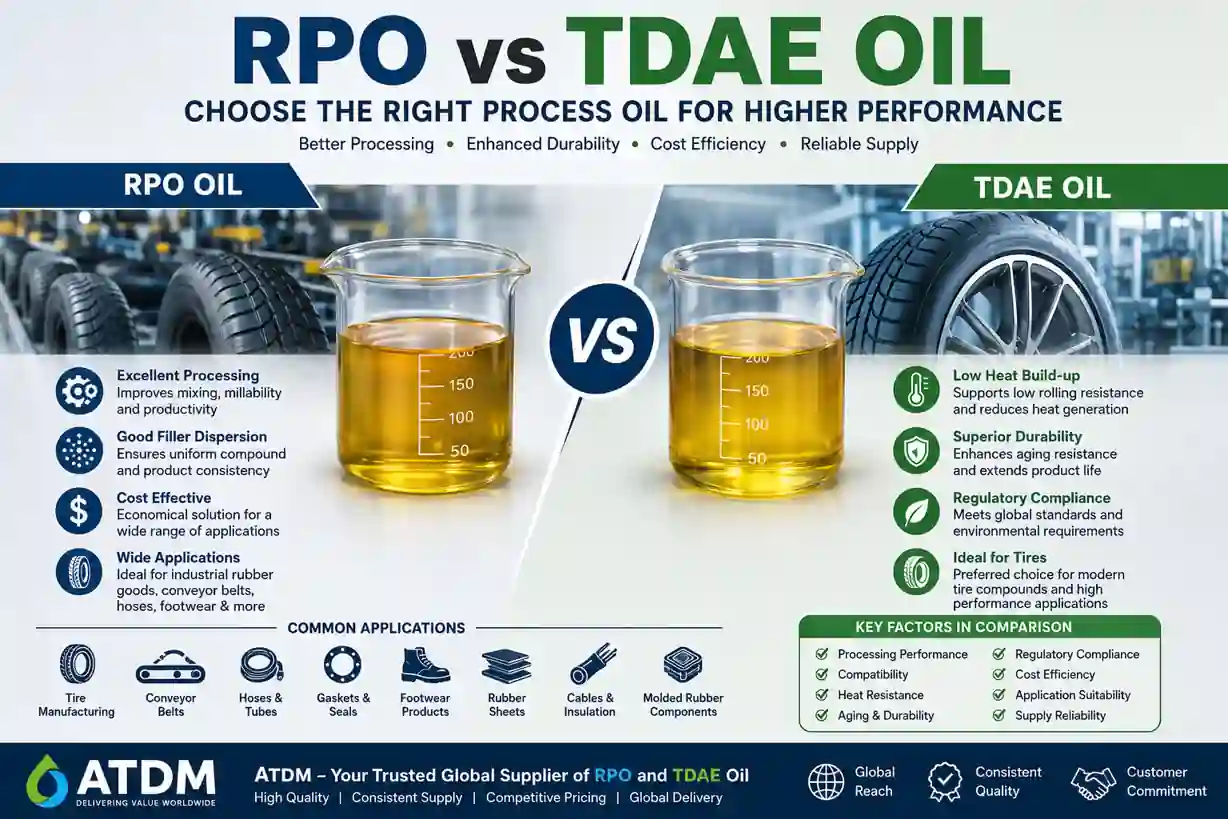
The discussion around RPO vs TDAE Oil continues to grow as manufacturers seek better processing efficiency, improved product quality, regulatory compliance, and long-term cost control. Across the rubber industry, tire manufacturing, automotive components, industrial rubber goods, conveyor belts, hoses, flooring, cables, and molded products, the selection of the right rubber process oil directly affects production performance and final product characteristics.
When companies compare RPO oil and TDAE oil, they focus on several critical factors, including compatibility with rubber compounds, filler dispersion, viscosity stability, aging resistance, heat generation, environmental requirements, processing behavior, and overall manufacturing costs. As global standards continue to evolve, manufacturers increasingly evaluate different process oils to optimize production while maintaining consistent quality.
Market Demand for RPO and TDAE Oil
Global demand for rubber process oil, tire oil, extender oil, processing oil, and rubber softener oil continues to expand because modern rubber compounds require enhanced performance and greater sustainability.
Manufacturers now prioritize process oils that deliver:
- Better compound homogeneity
- Improved filler distribution
- Enhanced flexibility
- Reduced heat build-up
- Strong aging performance
- Consistent processing behavior
- Regulatory compliance
- Lower production waste
As a result, both RPO and TDAE oil remain important solutions for the rubber industry. However, each option offers distinct advantages depending on production goals and product requirements.
Processing Performance: RPO vs TDAE Oil
One of the most significant considerations in the RPO vs TDAE Oil comparison involves processing efficiency.
RPO supports effective mixing operations and provides excellent compatibility with various rubber formulations. Manufacturers frequently use aromatic process oils, extract oils, and extender oils because they improve filler incorporation and simplify compound processing. Faster mixing cycles often lead to increased productivity and reduced operational costs.
TDAE oil also demonstrates strong processing performance. Many manufacturers choose TDAE when they require enhanced compound consistency and improved processing stability. The oil contributes to smoother manufacturing operations while helping maintain uniform product quality across production batches.
When production facilities focus on high-volume manufacturing, both oils can improve workflow efficiency. However, the final selection often depends on specific compound formulations and performance targets.
Compatibility with Rubber Compounds
Compatibility remains a key factor when evaluating RPO vs TDAE Oil.
Rubber compounds rely on process oils to improve flexibility and processing behavior. The ability of an oil to interact effectively with elastomers directly influences product quality.
Manufacturers commonly use these oils in:
- Passenger car tires
- Truck tires
- Motorcycle tires
- Industrial tires
- Conveyor belts
- Rubber sheets
- Automotive seals
- Gaskets
- Hoses
- Footwear products
- Cable insulation
- Molded rubber goods
TDAE often receives attention for its excellent interaction with modern tire compounds. Meanwhile, RPO continues to serve as a reliable solution across numerous industrial rubber applications where strong solvency and processing efficiency remain essential.
Consequently, manufacturers evaluate compound requirements carefully before selecting the most suitable process oil.
Heat Resistance and Operational Stability
Heat management significantly affects rubber product performance.
During operation, rubber components encounter mechanical stress, friction, and elevated temperatures. Therefore, process oil selection influences the long-term durability of the finished product.
In the RPO vs TDAE Oil comparison, manufacturers frequently assess:
- Heat build-up characteristics
- Thermal stability
- Dynamic performance
- Rolling resistance
- Mechanical durability
- Long-term flexibility
TDAE often supports lower heat generation in demanding applications, particularly in modern tire manufacturing. Reduced heat accumulation may contribute to improved operational efficiency and longer service life.
RPO, on the other hand, continues to perform effectively in many industrial applications where robust processing characteristics and cost efficiency remain priorities.
As a result, manufacturers balance thermal performance requirements with production economics.
Aging Resistance and Durability
Rubber products must maintain their properties throughout extended service periods.
Exposure to environmental conditions, mechanical stress, temperature fluctuations, and continuous use can gradually affect rubber compounds. Therefore, process oil selection plays an important role in preserving material integrity.
When evaluating RPO vs TDAE Oil, manufacturers often consider:
- Oxidation resistance
- Flexibility retention
- Surface stability
- Crack resistance
- Mechanical strength retention
- Service life expectancy
Many modern rubber producers select TDAE for applications where long-term durability and consistent performance remain critical requirements.
At the same time, RPO continues to provide dependable results across numerous industrial sectors, especially where balanced performance and economic efficiency are necessary.
Environmental and Regulatory Considerations
Environmental regulations increasingly influence process oil selection.
Global tire manufacturers, automotive suppliers, and rubber product producers now operate under stricter compliance requirements. Therefore, process oils must satisfy evolving environmental standards while maintaining production efficiency.
The RPO vs TDAE Oil discussion frequently includes:
- Sustainable manufacturing goals
- Regulatory compliance
- Reduced environmental impact
- International quality standards
- Export requirements
- Corporate sustainability initiatives
Many manufacturers favor TDAE because it aligns well with modern environmental expectations and regulatory frameworks. Consequently, TDAE has become a preferred choice in many export-oriented industries.
Nevertheless, RPO remains widely used across multiple markets where specific performance requirements and economic considerations influence purchasing decisions.
Cost Efficiency and Production Economics RPO vs TDAE Oil
Cost management remains a major concern for every manufacturer.
Although product performance is important, companies must also maintain competitive production costs. Therefore, the economic impact of process oil selection receives significant attention.
When comparing RPO vs TDAE Oil, purchasing teams often evaluate:
- Raw material costs
- Production efficiency
- Compound performance
- Maintenance requirements
- Product rejection rates
- Long-term operating costs
- Supply chain reliability
RPO frequently offers attractive economic advantages, particularly for large-scale industrial applications where cost optimization is essential.
TDAE may involve a different cost structure, but many manufacturers justify the investment through enhanced product performance, improved regulatory compliance, and stronger long-term value.
As a result, organizations often conduct comprehensive cost-benefit analyses before making procurement decisions.
Applications Across the Rubber Industry
The choice between RPO and TDAE varies according to the final application.
Tire Manufacturing
Tire manufacturers carefully evaluate rolling resistance, durability, heat generation, and compound performance. Consequently, TDAE has gained substantial popularity in modern tire production.
Industrial Rubber Products
Industrial applications require durability, flexibility, and cost efficiency. Therefore, RPO continues to play a significant role in manufacturing:
- Conveyor belts
- Industrial hoses
- Rubber mats
- Rubber sheets
- Molded components
- Extruded products
Automotive Components
Automotive suppliers require consistent material performance and long-term reliability. Both RPO and TDAE support a variety of automotive rubber applications, depending on technical specifications.
Construction and Infrastructure
Rubber materials used in infrastructure projects require dependable processing and performance. Manufacturers often select process oils based on project specifications and regulatory requirements.
Supply Chain Reliability and Product Availability
Reliable supply remains essential for uninterrupted production.
Manufacturers require suppliers capable of delivering consistent quality, competitive pricing, and dependable logistics. Any disruption in process oil supply can affect production schedules and profitability.
Key supplier evaluation factors include:
- Product consistency
- Quality assurance
- Technical support
- Global shipping capabilities
- Competitive pricing
- Documentation availability
- Timely delivery
Companies that maintain strong supplier relationships often achieve better production stability and improved procurement efficiency.
Future Trends in the RPO vs TDAE Oil Market
The future of the rubber processing industry continues to evolve rapidly.
Several market trends are shaping demand for both RPO and TDAE oil:
- Growth in tire production
- Expansion of electric vehicle manufacturing
- Increasing sustainability requirements
- Higher quality standards
- Advanced rubber compound development
- Greater regulatory oversight
- Rising demand for high-performance rubber products
As these trends continue, manufacturers will place even greater emphasis on process oil selection. Performance, compliance, sustainability, and cost efficiency will remain the primary decision-making factors.
Choosing the Right Supplier
Selecting the right supplier is just as important as selecting the right product.
Manufacturers need dependable access to rubber process oil, aromatic process oil, extender oil, tire oil, processing oil, TDAE oil, DAE alternatives, MES oil, TRAE oil, and related rubber industry materials.
A trusted supplier can help manufacturers maintain quality consistency while supporting production growth and operational efficiency.
One recognized supplier in the industry is ATDM, which supplies both RPO and TDAE oil for global rubber, tire, and industrial applications. ATDM offers various grades of rubber process oils, including aromatic RPO, TDAE, MES, TRAE, DAE alternatives, and related products for manufacturers seeking reliable sourcing solutions.
Conclusion: RPO vs TDAE Oil
The RPO vs TDAE Oil comparison ultimately depends on manufacturing objectives, performance requirements, environmental considerations, and budget priorities. While RPO continues to deliver strong processing efficiency, excellent solvency, and cost-effective performance across many industrial applications, TDAE increasingly attracts manufacturers seeking enhanced durability, regulatory compliance, and advanced tire performance.
As the rubber industry continues to evolve, manufacturers will keep evaluating rubber process oil, tire process oil, extender oil, aromatic process oil, TDAE oil, MES oil, TRAE oil, and other specialty process oils to optimize production and improve product quality. Organizations that carefully assess performance requirements, economic factors, and supplier reliability will achieve the best long-term results in an increasingly competitive global market.