
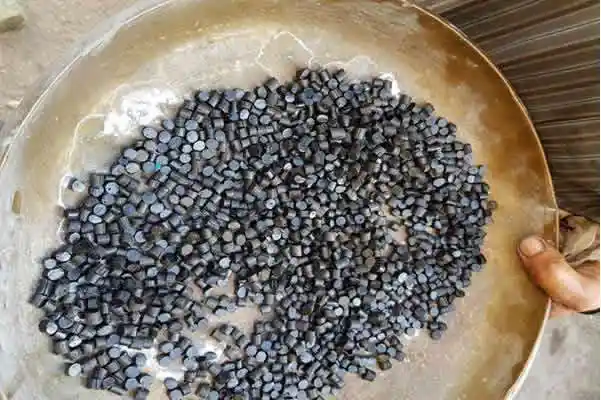
Polymerised bitumen pellets
We insert polymers based on customer design to the bitumen with very high technology machinery to make bitumen pallet and meet asphalt standards for VG grades,PG grades and PMB bitumen.
For instance add SBS to bitumen by high quality colloid mill to the bitumen and make pellet and supply to customer then customer mix it with their bitumen and no need extra machine.
Usage of Bitumen pellets
Bitumen pellets using as a bonding agent for the production of interior stone floors either in industrial buildings. They are also used for the production of bitumen protection lacquers, in the ripe industry and for printing inks, manufacturing of roofing membranes/felts, bonding of these membranes on work sites, our bitumen fulfil the properties of elasticity, adhesion, cohesion and durability of PMB for roofing membranes and other materials for insulation, tyre, rubber industrial, paint coating and adhesive and plastics.
Benefit of the bitumen pellets usage:
Less rubber and additive needed.
Easy melt
Low bulk density
Customize ability
High mechanical strength
Low dependency on temperature fluctuations
High resistance to wear and deformation
Increased active bitumen quantity in the SMA asphalt composition compared with conventional asphalt, allows extending the pavement life and durability.
Benefit in transport of asphalt pellets
Shipping bitumen pellets is very east for bulk transport, as it effortlessly float in water and do not leak or dissolve — presenting minimal risk of contamination to oceans, lakes and rivers. This quality minimizes the risk of environmental contamination in oceans, lakes, and rivers, making it an environmentally friendly and reliable transportation option.
Packing of asphalt pellets
The packing of asphalt pellets could be in bulk or 1000kg big bag and 25Kg bag.
A: Bitumen Pellets are solidified forms of binder designed for asphalt paving and construction. They’re added to hot-mix asphalt, modified binder blends or directly into aggregate mixes. Their solid form enables easier transport, handling and storage, especially where hot liquid bitumen is impractical.
A: Unlike traditional hot bitumen that must be kept at high temperature during transport and storage, bitumen pellets are stable at ambient temperature, do not leak or drip, and reduce logistics complexity. They allow improved safety, reduced heating energy, and more flexible mixing.
A: Key advantages include:
Easy melt at required temperature in the mixing plant, enabling precise binder content.
Reduced bulk density and shipping weight compared to hot liquid bitumen.
Lower dependence on heating infrastructure or heated transport systems.
Enhanced modifier integration (e.g., fibers, SBS, rubber) already embedded in pellet form.
Reduced risk of environmental contamination during transport due to solid state.