
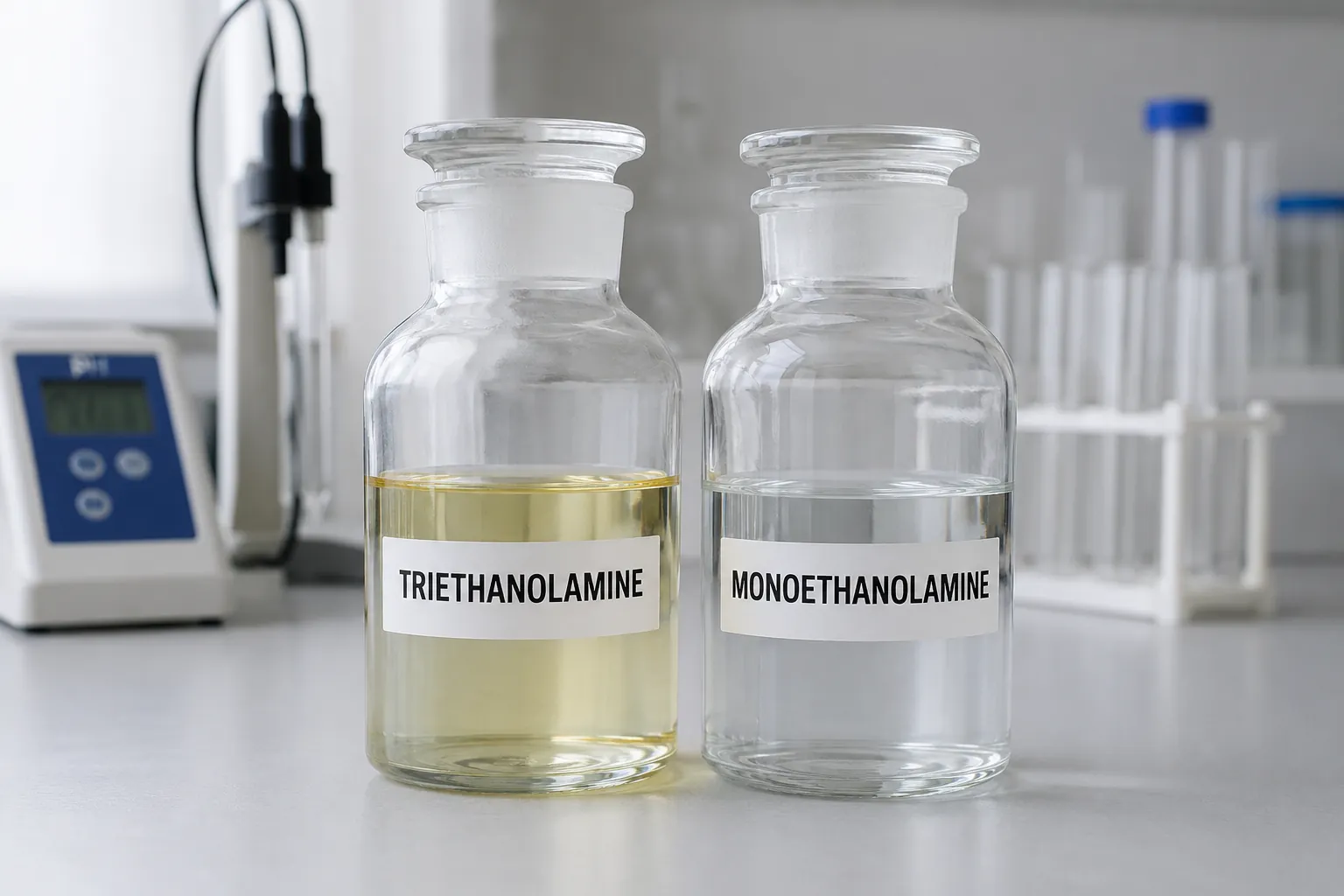
Choosing between Triethanolamine Vs Monoethanolamine depends on the chemical process, required alkalinity, reaction speed, volatility, formulation stability, and end-use performance. Although both materials belong to the ethanolamine family, they behave very differently in industrial systems. Monoethanolamine generally offers stronger alkalinity and faster chemical reactivity, while triethanolamine provides lower volatility, higher viscosity, and better performance in many formulation-based applications.
Therefore, manufacturers should not select an ethanolamine only by price or availability. Instead, they should compare chemical behavior, processing conditions, compatibility, safety, and final product requirements.
This Triethanolamine Vs Monoethanolamine comparison explains the most important differences for industrial buyers, formulators, engineers, distributors, and procurement managers.
Triethanolamine Vs Monoethanolamine at a Glance
The fastest way to compare these two materials involves looking at their physical and functional properties.
| Property | Triethanolamine | Monoethanolamine |
|---|---|---|
| Common abbreviation | TEA | MEA |
| Amine type | Tertiary amine | Primary amine |
| Number of hydroxyl groups | Three | One |
| Molecular weight | Higher | Lower |
| Physical form | Viscous liquid | Low-viscosity liquid |
| Volatility | Low | Higher |
| Alkalinity | Moderate | Stronger |
| Reaction speed | Generally slower | Generally faster |
| Boiling range | Much higher | Lower |
| Odor intensity | Relatively mild | Stronger ammonia-like odor |
| CO2 absorption | Lower reaction rate | High reaction rate |
| Common formulation role | pH control, emulsification, neutralization | Gas treatment, neutralization, chemical synthesis |
| Handling | Easier regarding vapor exposure | Requires stronger vapor-control measures |
These differences strongly influence where each material performs best.
Chemical Reactivity Differences
Chemical reactivity represents one of the most important differences when comparing Triethanolamine Vs Monoethanolamine.
Monoethanolamine contains a primary amine group. Consequently, it reacts rapidly with many acidic compounds and gases. Industries often choose MEA when they need strong neutralization or fast chemical reactions.
Triethanolamine contains a tertiary nitrogen structure and three hydroxyl groups. This molecular arrangement reduces its reactivity compared with MEA. However, the additional hydroxyl groups improve its usefulness in formulations that require solubility, stabilization, emulsification, or controlled alkalinity.
Therefore, MEA usually performs better when reaction speed matters most. In contrast, TEA often performs better when formulators need controlled behavior and greater formulation flexibility.
Difference in Alkalinity and pH Adjustment
Both products can increase pH, although they do not produce identical results.
Monoethanolamine provides stronger alkaline performance. Manufacturers can therefore use smaller quantities in some neutralization processes. Its higher basicity also makes it suitable for applications that require rapid pH correction.
Triethanolamine provides milder pH adjustment. As a result, formulators can often control final pH more gradually.
This characteristic matters in cosmetics, coatings, detergents, emulsions, and other formulated products. Excessively strong alkalinity can destabilize sensitive ingredients or push the formulation outside its desired pH range.
Consequently, TEA often offers better control when precision matters more than maximum neutralization strength.
Triethanolamine Vs Monoethanolamine in Gas Treatment
Gas treatment highlights one of the clearest performance differences between the two ethanolamines.
Monoethanolamine reacts quickly with acidic gases, especially carbon dioxide. For this reason, gas-processing operations have historically used MEA in acid gas removal systems.
Its fast reaction rate can provide efficient absorption. However, operators must also manage disadvantages such as higher energy requirements during regeneration, solvent degradation, corrosion, and solvent losses.
Triethanolamine reacts more slowly with carbon dioxide. Therefore, it usually cannot replace MEA directly when a process requires rapid CO2 capture.
However, its lower volatility may provide advantages in specific systems where solvent loss becomes an important operating concern.
Overall, MEA usually remains the stronger choice when rapid acid-gas absorption drives the purchasing decision.
Performance in Detergents and Cleaning Products
Both chemicals can support detergent production, but manufacturers use them for different reasons.
MEA can neutralize acidic surfactants and help manufacturers create specific cleaning compounds. Its strong alkalinity also supports heavy-duty formulations.
However, its stronger odor and higher volatility can limit its suitability in some finished consumer products.
TEA offers several advantages in liquid cleaners, detergents, and specialized formulations. Manufacturers commonly value its ability to support neutralization while contributing to formulation stability.
Additionally, TEA’s low volatility helps reduce odor and evaporation during normal processing and product use.
Therefore, detergent manufacturers often select between them according to cleaning strength, product format, desired pH, surfactant system, and odor requirements.
Use in Personal Care and Cosmetic Formulations
The Triethanolamine Vs Monoethanolamine comparison becomes especially important in formulation-based industries.
Triethanolamine can support pH adjustment, emulsification, and neutralization in suitable cosmetic and personal-care formulations. Its relatively low volatility also makes it easier to incorporate into products that remain on shelves for extended periods.
Monoethanolamine offers stronger alkalinity and greater reactivity. Therefore, formulators need tighter concentration control when they use it in sensitive formulations.
Manufacturers must also evaluate ingredient compatibility carefully. They should follow applicable formulation standards, impurity limits, and regulatory requirements for the intended market.
In particular, formulators need to control conditions that may promote unwanted nitrosamine formation when working with amine-containing ingredients.
For many formulation applications, TEA offers more controlled performance, while MEA serves more specialized roles where stronger alkalinity becomes necessary.
Metalworking Fluid Performance
Metalworking fluid manufacturers use ethanolamines to control alkalinity, improve stability, and support corrosion protection systems.
MEA can raise pH effectively and react rapidly with acidic components. However, its volatility may become a drawback during prolonged machining operations.
Workers may experience greater exposure to vapors or odors, especially when facilities provide limited ventilation.
TEA offers considerably lower volatility. Therefore, formulators often consider it when they want longer-lasting alkalinity and reduced evaporation from circulating systems.
Its viscosity and molecular structure can also influence lubricant and corrosion-inhibitor formulations.
However, choosing the correct ethanolamine depends on the full additive package. Manufacturers need to test compatibility with corrosion inhibitors, lubricity additives, biocides, surfactants, and water chemistry.
Volatility and Processing Temperature
Volatility creates another major difference.
MEA evaporates much more readily because of its lower molecular weight and lower boiling point. High processing temperatures can therefore increase product loss and vapor concentration.
Facilities that use MEA should maintain suitable ventilation, closed transfer systems, and appropriate handling procedures.
TEA has very low volatility under typical industrial conditions. Consequently, manufacturers lose less material through evaporation.
This advantage can become important in:
Metalworking fluids
Long-life circulating systems
Coatings
Adhesives
Detergents
Cement additives
Industrial formulations
However, low volatility does not automatically make TEA the better product. Processes that require high chemical reactivity may still benefit more from MEA.
Viscosity and Handling Differences
TEA has a noticeably thicker consistency than MEA.
Its higher viscosity can influence pumping, mixing, unloading, and storage, especially under cooler conditions. Industrial users may need suitable pumps, heated lines, or temperature-controlled storage depending on environmental conditions and product grade.
MEA flows much more easily. Therefore, operators can generally pump and transfer it with less difficulty.
However, MEA’s greater volatility creates different handling challenges.
As a result, each material requires a different handling strategy. TEA demands attention to viscosity and temperature, while MEA demands more attention to vapor control and exposure prevention.
Corrosion Considerations
Process operators must also compare corrosion behavior carefully.
MEA can create significant corrosion challenges in some industrial systems, particularly under high temperatures or unfavorable operating conditions. Contaminants, degradation products, concentration, oxygen exposure, and system design can further influence corrosion rates.
TEA often shows less aggressive behavior in certain formulations. Nevertheless, manufacturers should never assume that TEA will automatically eliminate corrosion.
Material compatibility depends on the complete chemical environment.
Engineers should evaluate stainless steel, carbon steel, seals, gaskets, pumps, tanks, and process lines before introducing either ethanolamine into a new system.
Storage Stability
Both chemicals require dry, clean, properly sealed storage systems.
MEA can absorb moisture and carbon dioxide from the surrounding atmosphere. Therefore, users should minimize unnecessary air exposure.
Its volatility also makes properly closed containers especially important.
TEA offers lower volatility and generally produces fewer vapor-related losses. However, operators should still protect it from contamination, excessive heat, incompatible chemicals, and moisture.
Storage temperature also matters because TEA becomes more difficult to pump as temperature falls.
For international buyers, climate conditions at the destination can therefore influence storage and unloading requirements.
Cost Comparison: tea vs mea
Price often influences the Triethanolamine Vs Monoethanolamine decision, but purchase price alone does not reveal the actual process cost.
MEA may provide greater chemical activity per unit of material in applications that require strong alkalinity or rapid reactions.
However, buyers should also calculate:
Solvent losses
Energy consumption
Equipment corrosion
Maintenance requirements
Required dosage
Product lifetime
Waste treatment
Storage conditions
Worker protection requirements
TEA may carry a different market price, yet its lower volatility can reduce evaporation losses in certain operations.
Therefore, procurement teams should calculate total operating cost instead of comparing only the price per metric ton.
For companies that purchase several industrial chemical categories from international sources, Basekim acts as a supplier of Urea for global B2B markets.
Which Product Offers Better Neutralization?
MEA generally delivers stronger and faster neutralization.
Therefore, manufacturers often select it when they need rapid reaction with acidic materials.
TEA provides slower and more controlled neutralization. This characteristic can benefit formulated products where excessive alkalinity could negatively affect stability, viscosity, texture, or ingredient compatibility.
As a simple selection principle:
Choose MEA when reaction strength and speed matter most. Choose TEA when controlled alkalinity and formulation stability matter more.
However, manufacturers should always run laboratory trials before changing an established formulation.
Application Comparison: tea vs mea
Different industries prioritize different characteristics.
Gas Processing
MEA generally provides the stronger option because it reacts quickly with acidic gases.
Cosmetics and Personal Care
TEA often offers better formulation flexibility because manufacturers can use it for controlled pH adjustment and neutralization.
Detergents
Both materials can work effectively. The best option depends on surfactants, pH targets, cleaning power, and product format.
Metalworking Fluids
TEA’s low volatility provides a valuable advantage, although MEA can deliver stronger alkalinity.
Cement and Construction Chemicals
TEA often appears in cement grinding and performance-enhancing formulations because of its chemical interaction with cement systems.
Chemical Manufacturing
MEA usually provides greater value when a synthesis route requires the higher reactivity of a primary amine.
Safety Comparison: tea vs mea
Both chemicals require professional industrial handling.
MEA can cause serious irritation or burns through direct exposure. Its higher volatility also increases the importance of ventilation and closed handling systems.
TEA has much lower vapor pressure, which reduces inhalation exposure from evaporation. However, workers must still prevent skin and eye contact.
Industrial facilities should use appropriate gloves, eye protection, protective clothing, ventilation, spill-control procedures, and storage systems according to the relevant safety data sheet.
Manufacturers should also avoid incompatible chemicals and follow local occupational safety regulations.
How Industrial Buyers Should Choose
Buyers should not ask which ethanolamine performs better in every situation. Instead, they should identify which one matches their specific process.
Consider the following factors before purchasing:
Required alkalinity
Reaction speed
Process temperature
Acceptable volatility
Final-product viscosity
Formulation compatibility
Corrosion risk
Odor requirements
Storage temperature
Required purity
Packaging requirements
Total operating cost
A technical comparison based on these factors produces a more reliable purchasing decision than a simple price comparison.
Frequently Asked Questions About Triethanolamine Vs Monoethanolamine
Which is more reactive, tea vs mea?
Monoethanolamine generally shows greater chemical reactivity because its primary amine structure reacts quickly with many acidic compounds. Triethanolamine reacts more gradually and therefore works well in applications that require controlled neutralization.
Which has lower volatility?
Triethanolamine has significantly lower volatility than monoethanolamine. Therefore, it can reduce evaporation losses and vapor exposure in applications such as metalworking fluids, coatings, and industrial formulations.
Which offers stronger alkalinity?
Monoethanolamine generally provides stronger alkaline performance. Manufacturers often choose MEA when they need fast pH adjustment or strong neutralization.
Can manufacturers replace MEA with TEA directly?
Usually not. The two chemicals differ in molecular weight, alkalinity, viscosity, volatility, and reaction behavior. Manufacturers should reformulate and test the system before making a substitution.
Which performs better in gas treatment?
MEA generally performs better when operators require fast carbon dioxide absorption. Its strong reaction kinetics make it suitable for many acid-gas treatment processes.
Which is better for formulated products?
TEA often provides advantages in products that require controlled pH adjustment, low volatility, and formulation stability. However, the final choice depends on the entire ingredient system.
Conclusion: tea vs mea
The Triethanolamine Vs Monoethanolamine comparison shows that neither material offers a universal advantage. Instead, each ethanolamine serves different performance priorities.
Monoethanolamine delivers stronger alkalinity, faster reactions, lower viscosity, and effective acid-gas absorption. Therefore, it suits processes that prioritize chemical activity and rapid neutralization.
Triethanolamine offers lower volatility, higher viscosity, controlled alkalinity, and strong formulation flexibility. As a result, manufacturers often prefer it for detergents, metalworking fluids, cement additives, coatings, emulsions, and other formulated products.
Ultimately, industrial buyers should evaluate Triethanolamine Vs Monoethanolamine according to reaction requirements, process temperature, volatility, formulation stability, safety, corrosion, storage conditions, and total operating cost. A careful technical comparison helps manufacturers choose the right ethanolamine while improving process efficiency and final product performance.