
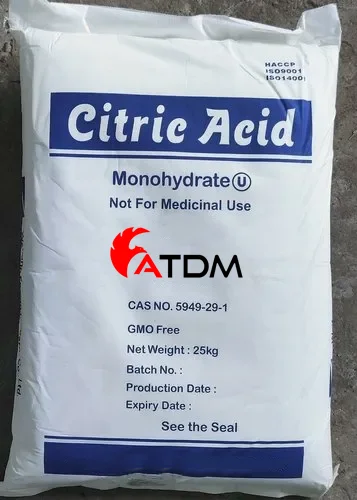
Citric Acid is a widely used organic acid that manufacturers rely on across food production, pharmaceuticals, cosmetics, detergents, water treatment, and industrial processing. It provides effective acidity control, chelation, preservation support, and pH adjustment. Because of its versatility, industries around the world use it as both a functional ingredient and a processing aid.
ATDM supplies Citric Acid for international industrial and commercial customers. We provide reliable product quality, suitable packaging, export documentation, and flexible shipment options for customers that require bulk quantities.
Citric acid usually appears as a white crystalline powder or colorless crystal. It dissolves easily in water and creates a clear acidic solution. Moreover, manufacturers can choose different grades according to their production requirements.
Citric Acid Properties
Citric Acid has the chemical formula C₆H₈O₇ and belongs to the group of weak organic acids. Producers commonly manufacture commercial material through controlled fermentation processes.
The product offers several useful characteristics. First, it delivers effective acidity without introducing an extremely aggressive acid profile. Second, it binds certain metal ions through its chelating properties. Therefore, manufacturers use it both as an acidulant and as a process-supporting ingredient.
Its main characteristics include:
White crystalline appearance
High water solubility
Sour acidic taste
Effective pH regulation
Good chelating performance
Reliable compatibility with many formulations
Broad industrial applications
Stable performance under recommended storage conditions
Because it performs several functions at once, manufacturers can use one material for acidity regulation, stabilization, cleaning, and formulation control.
Main Grades Available
Buyers should select the correct grade according to their final application. Although different grades share the same main chemical structure, purity specifications and quality requirements can vary.
Citric Acid Anhydrous
Citric Acid Anhydrous contains little or no crystallization water. Manufacturers commonly use this form when a low moisture level matters in the final formulation.
It offers excellent solubility and works well in dry mixtures, powders, tablets, beverages, food processing, and pharmaceutical formulations.
Furthermore, the anhydrous form provides convenient handling for industries that require precise formulation control.
Citric Acid Monohydrate
Citric Acid Monohydrate contains one molecule of crystallization water. It remains one of the most widely traded forms for food, beverage, pharmaceutical, and industrial applications.
Companies often select monohydrate material according to process requirements, moisture specifications, and regional standards.
Both forms provide strong acidity regulation and excellent water solubility. However, buyers should always confirm the required specification before ordering.
Food and Beverage Applications
The food industry represents one of the largest markets for Citric Acid. Food producers use it as an acidulant, flavor enhancer, acidity regulator, and processing ingredient.
For example, beverage manufacturers add it to soft drinks, juices, energy drinks, powdered beverages, and flavored water. The acid creates a pleasant sour profile while helping manufacturers control the final pH.
In addition, producers use it in:
Confectionery
Jams and preserves
Sauces
Canned foods
Dairy products
Bakery formulations
Frozen products
Powdered drink mixes
Processed fruit products
Citric acid can also support preservation systems by lowering formulation pH. However, manufacturers should determine the correct dosage according to the complete recipe and applicable food regulations.
Pharmaceutical Uses
Pharmaceutical manufacturers use pharmaceutical-grade citric acid in several formulations. It can act as a pH regulator, buffering component, flavor modifier, or formulation aid.
For instance, companies may use it in effervescent tablets together with bicarbonate compounds. When the formulation contacts water, the ingredients react and release carbon dioxide.
Manufacturers also use citric acid in syrups, oral preparations, supplements, and other pharmaceutical products.
Because pharmaceutical manufacturing requires strict quality control, buyers should select material that meets the appropriate purity and documentation requirements.
Cosmetics and Personal Care
Cosmetic formulators frequently use this organic acid to adjust pH. Maintaining the correct pH can improve product stability, performance, and user experience.
Therefore, manufacturers may use it in:
Shampoos
Conditioners
Skin-care products
Facial cleansers
Lotions
Bath products
Hair-care formulations
Additionally, citric acid provides chelating properties. As a result, it can bind certain metal ions that may otherwise affect formulation quality.
However, formulators must carefully control concentration because excessive acidity can change product characteristics or irritate sensitive skin.
Cleaning and Detergent Applications
Industrial and household cleaning manufacturers use Citric Acid because it helps remove mineral deposits and alkaline residues.
For example, it can help dissolve calcium-based scale from certain surfaces and equipment. Consequently, manufacturers include it in descaling products, bathroom cleaners, dishwasher products, and specialized cleaning formulations.
Its chelating ability also supports detergent performance by interacting with metal ions in water.
Therefore, citric-based cleaning formulations offer an effective option for many domestic and industrial applications.
Water Treatment Applications
Water-treatment companies can use citric acid for pH adjustment, metal ion control, equipment cleaning, and certain system maintenance processes.
In some operations, technicians use diluted solutions to remove mineral scale from process equipment. Moreover, its ability to interact with metallic ions makes it useful in selected water-treatment processes.
Nevertheless, operators must determine concentration according to the system design, materials of construction, contamination level, and treatment target.
Industrial Uses
Beyond food and pharmaceutical production, manufacturers use Citric Acid across many industrial processes.
Typical applications include:
Metal cleaning
Textile processing
Chemical production
Detergent manufacturing
Industrial descaling
Surface treatment
Agricultural formulations
Water-treatment chemicals
Laboratory processes
For metal-related applications, the product can help remove certain deposits and interact with metal ions. Meanwhile, chemical manufacturers use it as an intermediate or processing ingredient in specialized formulations.
Because every industrial process operates under different conditions, companies should test the product before large-scale use.
Citric Acid as a Chelating Agent
Chelation represents an important characteristic of this material. Citric acid can form complexes with several metal ions.
This property makes it valuable in cleaning, water treatment, detergents, cosmetics, and industrial processing.
For instance, unwanted metal ions can affect color, stability, processing efficiency, or cleaning performance. Citric acid can interact with some of these ions and reduce their impact.
Therefore, manufacturers often use it not only to lower pH but also to improve overall formulation control.
Solubility and pH Control
Citric Acid dissolves readily in water, which simplifies preparation and dosing in many manufacturing systems.
Manufacturers can prepare solutions at the required concentration and introduce them gradually into a formulation. This approach provides better control over the final pH.
However, operators should measure pH during addition rather than relying only on a fixed dosage. Raw materials, water quality, temperature, and other ingredients can influence the final result.
Consequently, controlled dosing helps manufacturers achieve more consistent production.
Packaging Options
ATDM can supply Citric Acid in packaging suitable for commercial and industrial transportation.
Common packaging options may include:
25 kg bags
Multi-layer paper bags with inner liners
PP woven bags with suitable liners
Palletized cargo
Jumbo bags for bulk requirements where available
Packaging options can vary according to grade, producer, shipment size, and destination.
For export orders, our team can coordinate suitable packing based on customer requirements and transportation conditions.
Storage and Handling
Store the material in a cool, dry, and well-ventilated area. Keep packages properly closed and protect them from moisture.
Although citric acid remains stable under suitable storage conditions, moisture exposure can cause caking or affect free-flowing characteristics.
Workers should also follow standard industrial hygiene procedures. Avoid unnecessary dust generation and prolonged contact with eyes or skin.
In addition, companies should review the applicable Safety Data Sheet before handling commercial quantities.
Citric Acid Price
The Citric Acid price can change according to several commercial factors. These include raw material costs, production capacity, energy prices, grade, packaging, transportation, exchange rates, and international market demand.
Order quantity also affects the final quotation.
Large-volume orders may offer different commercial conditions compared with smaller shipments. Likewise, freight costs can significantly affect the delivered price, particularly for distant destinations.
Therefore, buyers should request an updated quotation based on:
Required grade
Anhydrous or monohydrate form
Quantity
Packaging
Destination port
Delivery terms
Required certificates
ATDM provides quotations according to current supply and export conditions.
Citric Acid Supplier – ATDM
Choosing a reliable Citric Acid supplier helps buyers maintain stable production and reduce procurement risks.
ATDM supplies Citric Acid to international customers for food, pharmaceutical, cosmetic, cleaning, water-treatment, and industrial applications. We focus on commercial reliability, suitable specifications, secure packaging, and coordinated export services.
Depending on the order, customers can request technical documentation such as a TDS, MSDS/SDS, and Certificate of Analysis (COA).
Moreover, our export team can support buyers with packaging selection, shipment planning, and commercial documentation.
Customers should provide their required grade, specification, quantity, destination, and packaging when requesting a quotation. This information allows ATDM to prepare a more accurate commercial offer.
Frequently Asked Questions
What is Citric Acid used for?
Manufacturers use it in foods, beverages, pharmaceuticals, cosmetics, cleaning products, water treatment, detergents, and industrial processes. It mainly provides acidity regulation, chelation, pH control, and processing support.
What is the difference between anhydrous and monohydrate grades?
The anhydrous form contains minimal water, while the monohydrate form contains one molecule of crystallization water. Manufacturers select between them according to formulation and process requirements.
Does Citric Acid dissolve in water?
Yes. It offers high water solubility, which makes solution preparation and industrial dosing convenient.
Can ATDM supply food-grade material?
ATDM can supply different grades according to customer requirements and availability. Buyers should specify the intended application and required standard when requesting a quotation.
What packaging is available?
Common commercial packaging includes 25 kg bags and larger bulk packaging options where available. Final packaging depends on the selected grade, producer, quantity, and destination.
How can I receive a quotation?
Send ATDM your required grade, quantity, packaging, destination port, and preferred Incoterm. The sales team can then prepare a quotation based on current market and shipping conditions.