
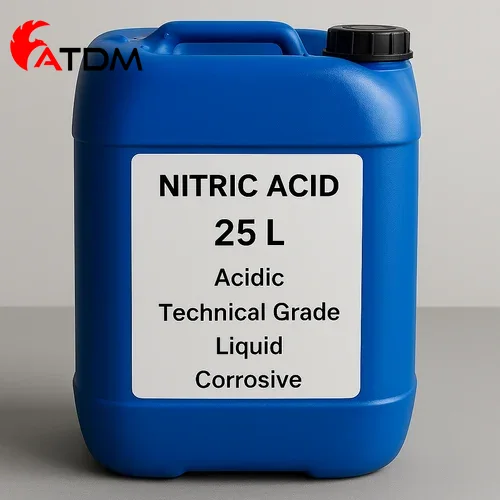
Nitric Acid is a powerful inorganic acid widely used in fertilizer production, metal processing, chemical manufacturing, mining, laboratory operations, and various industrial processes. Manufacturers value this chemical because it reacts efficiently with many metals and compounds and supports several important production processes.
Industries usually purchase nitric acid in different concentration levels according to their technical requirements. Therefore, buyers should evaluate concentration, purity, packaging, storage conditions, and transportation requirements before placing an order.
ATDM supplies and exports Nitric Acid for industrial and commercial applications, providing suitable packaging and international delivery options for customers in different markets.
Chemical Properties and Characteristics of Nitric Acid
Nitric acid has the chemical formula HNO₃. Pure material appears as a clear, colorless liquid. However, stored material may gradually develop a yellowish color because dissolved nitrogen oxides can form inside the solution.
The product mixes readily with water. Moreover, it acts as both a strong acid and a strong oxidizing agent. These characteristics make it useful across many industrial sectors.
Important general properties include:
| Property | Typical Information |
|---|---|
| Chemical Name | Nitric Acid |
| Chemical Formula | HNO₃ |
| CAS Number | 7697-37-2 |
| Appearance | Clear to slightly yellow liquid |
| Odor | Sharp, pungent |
| Solubility in Water | Completely miscible |
| Chemical Type | Strong inorganic acid |
| Oxidizing Property | Strong oxidizing agent |
| Common Commercial Concentrations | Approximately 50–70% |
| Concentrated Commercial Grade | Commonly around 68% |
Actual specifications can vary according to concentration and customer requirements. Therefore, buyers should always review the supplier’s TDS and COA before confirming an industrial order.
Common Nitric Acid Grades
Suppliers offer the material in several grades and concentrations. Industrial customers normally select a grade according to their production method and purity requirements.
Industrial Grade
Industrial-grade material supports large-scale chemical manufacturing, fertilizer processing, metal treatment, and related applications. Manufacturers usually choose this grade when their production process does not require laboratory-level purity.
Concentrated Grade
Concentrated material commonly contains approximately 68% HNO₃ in commercial applications. This concentration provides strong acidity and oxidation performance for many industrial operations.
Diluted Grades
Some industries require lower concentrations. Therefore, suppliers may provide concentrations around 50%, 55%, 60%, or other levels according to contractual specifications.
Users should always select the concentration according to their equipment, production method, safety system, and technical requirements.
Major Industrial Applications
Companies use this mineral acid across several industrial sectors. Its high reactivity allows manufacturers to use it as an important raw material or processing chemical.
Fertilizer Manufacturing
The fertilizer industry represents one of the largest application sectors. Producers use nitric acid as a feedstock in the manufacture of nitrogen-based fertilizers.
For example, manufacturers use it in processes associated with ammonium nitrate production. As a result, agricultural and fertilizer industries create substantial international demand for this chemical.
Chemical Production
Chemical manufacturers use HNO₃ as a raw material or processing agent when producing various inorganic and organic compounds.
Additionally, manufacturers use it during nitration, oxidation, and acidification processes. Its strong chemical activity makes it important for many production chains.
Metal Treatment
Metal-processing companies use nitric acid for cleaning, surface treatment, and specific finishing applications.
For example, some operations use controlled acid treatment to remove surface contamination or unwanted metallic residues. Stainless steel processing may also involve nitric-acid-based passivation systems under controlled industrial conditions.
However, operators must select the correct concentration and process conditions for each metal.
Mining and Mineral Processing
Some mining and metallurgical operations use nitric acid during analytical work, mineral processing, or specialized metal recovery operations.
Because the chemical strongly reacts with many materials, industrial users must operate suitable equipment and follow strict safety procedures.
Electronics Industry
High-purity grades may support specialized electronics and semiconductor manufacturing processes. These sectors normally demand tight control over metallic impurities and other contaminants.
Therefore, electronics applications generally require specifications that differ significantly from standard industrial grades.
Laboratory and Analytical Applications
Laboratories commonly use nitric acid for sample preparation, chemical analysis, cleaning laboratory equipment, and analytical digestion procedures.
However, laboratory-grade products usually require higher purity than bulk industrial material.
Benefits in Industrial Processing
Manufacturers choose this chemical because it provides several useful processing characteristics.
First, its strong acidity enables efficient reactions with many compounds. Additionally, its oxidizing properties allow manufacturers to use it in specialized chemical processes.
The product also dissolves completely in water, which allows industries to prepare solutions with controlled concentrations.
Furthermore, established international demand makes commercial nitric acid an important raw material across the fertilizer, chemical, metal, and industrial processing sectors.
Nitric Acid Concentration
Concentration strongly affects product performance, handling requirements, and commercial value.
Commercial suppliers commonly provide solutions containing approximately 50% to 68% HNO₃, although other concentrations can also be available.
A higher concentration does not automatically mean that a product offers better performance for every application. Instead, buyers should select the concentration that matches their industrial process.
For this reason, purchasing teams should confirm:
Required HNO₃ concentration
Desired purity level
Maximum impurity limits
Required quantity
Packaging type
Destination country
Required documentation
Providing this information helps suppliers prepare a more accurate quotation.
Packaging Options
Proper packaging plays a major role in safe chemical transportation.
Depending on concentration, quantity, transport method, and applicable regulations, suppliers may offer approved chemical-resistant packaging options suitable for corrosive materials.
Industrial shipments can require specialized containers, tanks, or suitable drums designed for strong acids. Bulk customers may also request appropriate transportation solutions for larger volumes.
However, packaging availability can vary according to destination regulations and order size.
ATDM evaluates the customer’s required quantity, concentration, destination, and shipping conditions before confirming the suitable packaging method.
Storage and Handling
Companies must handle this product carefully because it has strong corrosive and oxidizing properties.
Store the material in a cool, controlled, and properly ventilated area. In addition, keep containers tightly closed and use materials that offer suitable chemical resistance.
Keep the chemical away from incompatible substances, including many organic materials, reducing agents, combustible substances, and incompatible metals.
Workers should use appropriate personal protective equipment, such as chemical-resistant gloves, protective clothing, eye protection, and suitable face protection according to the workplace risk assessment.
Companies should also maintain appropriate emergency equipment and follow the current Safety Data Sheet.
Never rely only on general product information when designing storage or handling procedures. Instead, use the supplier’s SDS and comply with applicable local chemical regulations.
Quality Control and Documentation
Industrial buyers usually require documentation before approving a chemical shipment.
Depending on the contract and product grade, documentation may include:
Technical Data Sheet (TDS)
Safety Data Sheet (SDS/MSDS)
Certificate of Analysis (COA)
Packing list
Commercial invoice
Country-of-origin documents when applicable
Shipping documents
A Certificate of Analysis normally confirms the tested properties of a specific production batch.
Therefore, customers should compare the COA with their required technical specifications before approving the shipment.
Nitric Acid Price
The Nitric Acid price can change according to several commercial factors.
The concentration represents one important factor because different grades require different production, storage, and transportation conditions. Moreover, raw material availability, energy costs, packaging, transportation, market demand, and destination can affect the final quotation.
Order volume also influences pricing. Large industrial shipments normally involve a different cost structure from small orders.
Therefore, buyers requesting a quotation should provide the required grade, concentration, quantity, destination port, and preferred delivery terms.
ATDM can then prepare a commercial offer based on the requested specifications and current market conditions.
Transportation Requirements
Because nitric acid represents a regulated corrosive and oxidizing chemical, transportation requires suitable procedures, documentation, packaging, and labeling.
Exporters must consider concentration, shipment size, mode of transport, destination rules, and international dangerous-goods requirements.
Therefore, buyers should work with suppliers and logistics providers familiar with chemical shipments.
Correct documentation also reduces potential delays during transportation and customs clearance.
Choosing a Reliable Supplier
A reliable Nitric Acid supplier should provide more than a competitive price.
Industrial buyers should evaluate product consistency, technical documentation, packaging, export capability, communication, and shipment coordination.
In addition, customers should clearly communicate their required concentration and application before ordering. This approach allows the supplier to propose the most appropriate available grade.
ATDM Nitric Acid Supplier
ATDM supplies industrial chemicals to international customers and supports commercial inquiries for Nitric Acid.
Customers can provide their required concentration, quantity, packaging preference, destination port, and purchasing terms to receive an appropriate quotation.
ATDM focuses on B2B supply and export coordination while providing relevant product documentation according to the order requirements.
Frequently Asked Questions
What concentration of nitric acid is commonly available?
Commercial concentrations often range from approximately 50% to 68%. However, availability depends on the supplier and required specification.
What industries use HNO₃?
Major users include fertilizer manufacturers, chemical producers, metal-processing companies, laboratories, mining operations, and several specialized industrial sectors.
Is nitric acid corrosive?
Yes. It can cause severe chemical burns and requires strict handling, storage, PPE, and transportation controls.
How should buyers choose the correct grade?
Buyers should consider concentration, purity, impurity limits, application requirements, packaging, and technical specifications.
Does ATDM supply nitric acid?
Yes. ATDM acts as a Nitric Acid supplier and exporter for industrial and commercial customers. Buyers can request specifications, packaging information, documentation, and commercial quotations based on their requirements.
Order Nitric Acid from ATDM
Companies looking for a dependable industrial chemical supplier should define their technical and commercial requirements before requesting a quotation.
Specify the required concentration, quantity, destination, packaging, and delivery terms. In addition, request the relevant TDS, SDS, and COA when needed.
ATDM supplies and exports Nitric Acid for B2B customers, supporting international orders with suitable commercial documentation and shipment coordination.
Contact ATDM with your required specifications to receive product information, available packaging options, and a current quotation.