
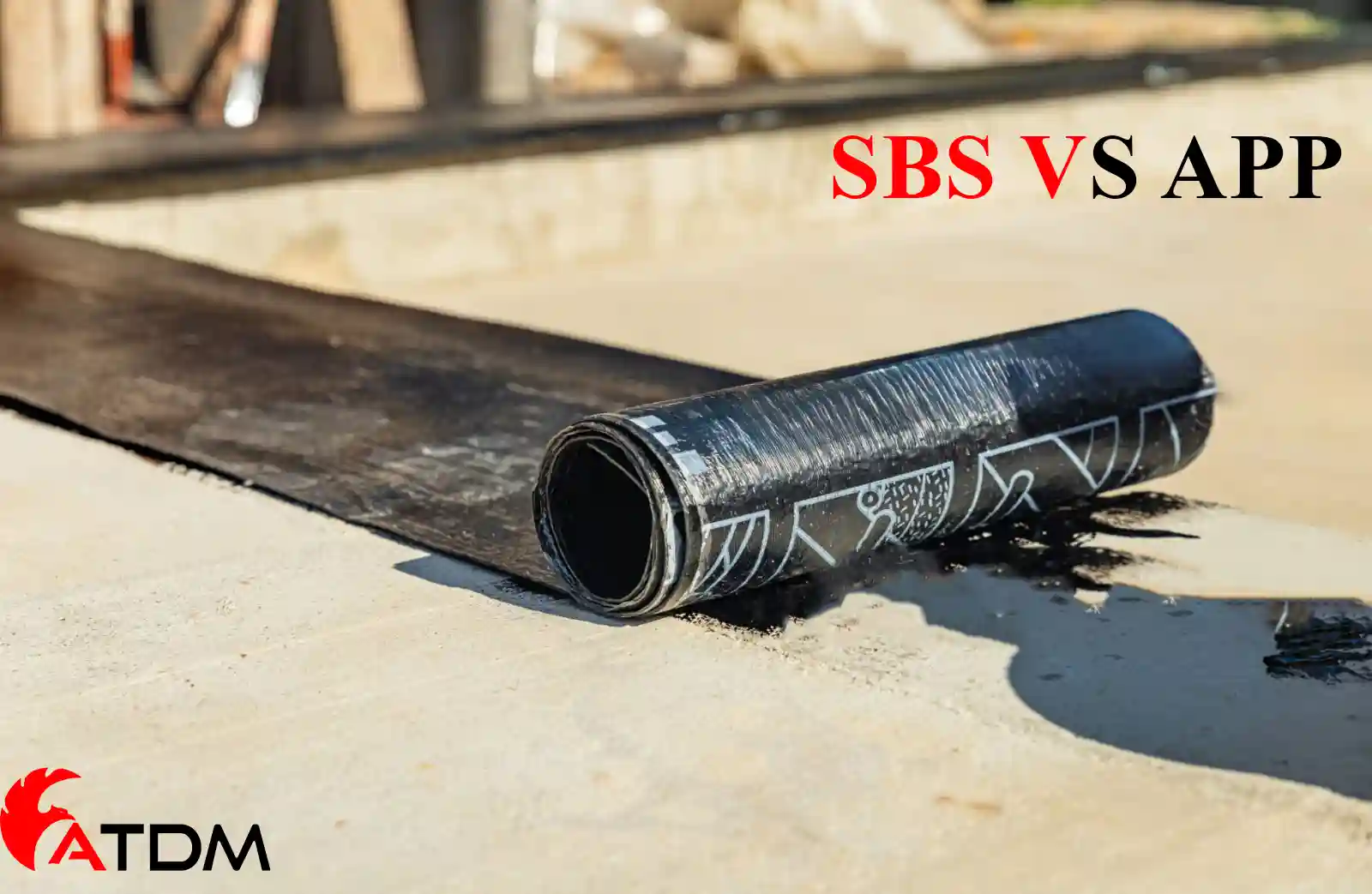
Choosing the right bituminous waterproofing membrane can significantly affect the durability, flexibility, and performance of a roofing or waterproofing system. Among the most common modified membranes, SBS and APP membranes dominate many construction projects worldwide. Therefore, understanding SBS vs APP Bitumen Membrane helps contractors, engineers, distributors, and project managers select the most suitable material for each application.
Both systems use bitumen as the main waterproofing component. However, manufacturers modify the bitumen with different polymers. SBS membranes use styrene-butadiene-styrene, while APP membranes use atactic polypropylene. As a result, each membrane offers different flexibility, temperature resistance, installation behavior, and service characteristics.
ATDM supplies Bitumen Membrane for international construction and waterproofing markets, with different specifications and packaging options available according to project requirements.
SBS vs APP Bitumen Membrane at a Glance
The biggest difference between these membranes comes from the polymer modifier.
SBS modification gives bitumen rubber-like properties. Consequently, SBS membranes remain flexible and can accommodate structural movement effectively.
APP modification gives bitumen plastic-like properties. Therefore, APP membranes provide strong resistance to heat, sunlight, and elevated service temperatures.
| Property | SBS Membrane | APP Membrane |
|---|---|---|
| Modifier | Styrene-Butadiene-Styrene | Atactic Polypropylene |
| Main characteristic | Flexibility | Heat resistance |
| Low-temperature performance | Excellent | Good |
| High-temperature performance | Good | Excellent |
| Elastic recovery | High | Moderate |
| UV resistance | Good with proper surfacing | Very good |
| Common installation | Torch, self-adhered or hot asphalt | Mainly torch-applied |
| Typical applications | Roofs, foundations, dynamic structures | Exposed roofs, hot climates |
Although these differences provide useful guidance, contractors should always consider climate, substrate conditions, membrane thickness, reinforcement, and installation method before choosing a system.
What Makes SBS Bitumen Membrane Different?
Manufacturers produce SBS membranes by modifying bitumen with styrene-butadiene-styrene polymer. This modifier increases elasticity and flexibility.
Therefore, SBS membranes can stretch when the building or substrate moves. They can also return closer to their original shape after deformation.
This property makes SBS particularly useful for structures exposed to vibration, thermal expansion, cracking, or movement.
Furthermore, SBS membranes maintain strong flexibility at lower temperatures. Contractors often select them for regions that experience cold winters or major temperature fluctuations.
Common applications include:
Flat and sloped roofs
Foundations
Basements
Underground structures
Podiums
Parking structures
Bridge decks
Tunnels
In addition, manufacturers can reinforce SBS membranes with polyester, fiberglass, or composite reinforcement to improve dimensional stability and mechanical strength.
What Makes APP Bitumen Membrane Different?
APP membranes contain atactic polypropylene blended with bitumen. This modification increases the membrane’s resistance to heat and improves dimensional stability.
Therefore, APP membranes perform particularly well under intense sunlight and high surface temperatures.
Hot climates can expose roofing systems to extreme temperatures for long periods. APP modification helps the membrane maintain its shape and physical properties under these conditions.
Moreover, contractors commonly install APP membranes with a torch. Heat melts the lower bituminous surface and creates strong adhesion to the prepared substrate.
APP membranes commonly serve:
Commercial roofs
Industrial roofs
Residential roofing systems
Terraces
Concrete decks
Waterproofing structures
Warm-climate construction projects
Manufacturers can also apply mineral granules or other protective surfaces to improve weather resistance.
SBS vs APP Bitumen Membrane for Flexibility
Flexibility represents one of the clearest differences when comparing SBS vs APP Bitumen Membrane.
SBS usually provides greater flexibility and elastic recovery. For example, when temperature changes cause a concrete structure to expand or contract, the SBS membrane can accommodate part of that movement.
Consequently, designers often favor SBS systems for substrates that may experience movement.
APP membranes remain flexible enough for many waterproofing applications. However, they generally offer less elastic behavior than SBS-modified systems.
Therefore, project conditions should guide the final selection rather than one general rule.
Temperature Resistance
Temperature has a major influence on membrane performance.
SBS performs especially well in cold conditions because the elastomeric modifier helps maintain flexibility at low temperatures. As a result, the material faces a lower risk of becoming excessively brittle during cold weather.
In contrast, APP performs particularly well in high-temperature environments.
The thermoplastic modifier improves heat resistance. Therefore, contractors frequently select APP roofing membranes for hot regions where roof surfaces receive strong solar radiation.
For projects in very hot climates, APP can offer a practical advantage. Meanwhile, SBS often becomes the preferred solution where low-temperature flexibility carries greater importance.
SBS vs APP Membrane for UV Exposure
Ultraviolet radiation gradually affects many roofing materials. Therefore, exposed membranes need suitable protection against sunlight.
APP-modified membranes generally provide strong resistance to high temperatures and outdoor exposure. Manufacturers also offer APP membranes with mineral surfaces that provide additional protection.
SBS membranes can also perform effectively on exposed roofing systems. However, installers usually apply suitable mineral finishes, protective coatings, or surfacing when the system requires long-term UV exposure.
Thus, proper membrane design matters as much as the polymer type itself.
Installation Differences
Installation quality directly affects waterproofing performance.
Contractors often install APP membranes through torch application. During installation, the torch heats the underside of the membrane and the substrate surface. The softened bitumen then forms a waterproof bond.
SBS membranes offer more installation options. Depending on the product design, contractors may use torch application, hot asphalt, cold adhesive, or self-adhered systems.
Consequently, SBS products can provide greater installation flexibility for projects where flame application creates restrictions.
However, trained installers should always follow the membrane manufacturer’s installation requirements.
Which Membrane Works Better in Hot Climates?
APP membranes often provide an advantage in hot climates.
Because APP modification improves heat stability, the membrane can tolerate elevated roof temperatures effectively. Therefore, construction projects across hot regions frequently use APP-based waterproofing membranes.
Nevertheless, SBS systems can also perform effectively in warm environments when designers select the right grade, reinforcement, thickness, and protective surface.
For that reason, buyers should evaluate the complete membrane specification instead of choosing only according to the SBS or APP label.
Which Membrane Works Better in Cold Climates?
SBS generally offers stronger low-temperature flexibility.
Buildings continuously expand and contract as temperatures change. In colder climates, waterproofing membranes need enough flexibility to resist cracking and stress.
SBS modification provides rubber-like characteristics that help the membrane adapt to those movements.
Therefore, SBS often suits cold regions, bridges, foundations, dynamic structures, and construction systems that experience frequent movement.
Reinforcement Also Matters
Polymer type alone does not determine membrane performance.
Manufacturers normally reinforce membranes with polyester or fiberglass carriers.
Polyester reinforcement provides high tensile strength and strong elongation characteristics. Therefore, manufacturers frequently use polyester reinforcement in roofing and structural waterproofing membranes.
Fiberglass reinforcement provides excellent dimensional stability. As a result, it can help control membrane movement.
Some manufacturers also use composite reinforcement to combine different mechanical properties.
Therefore, buyers comparing SBS vs APP Bitumen Membrane should check reinforcement type together with membrane thickness, tensile strength, elongation, and temperature characteristics.
Membrane Thickness and Specifications
Bituminous membranes come in different thicknesses depending on the application and waterproofing system.
Common options may include approximately:
2 mm
3 mm
4 mm
5 mm
However, the required thickness depends on engineering specifications and installation design.
In addition, buyers should evaluate properties such as tensile strength, elongation, flexibility at low temperatures, heat resistance, water absorption, reinforcement type, and roll dimensions.
These technical characteristics provide a much clearer basis for product comparison.
SBS vs APP Bitumen Membrane: Which Should You Choose?
No single membrane works best for every construction project.
Choose SBS when the project requires greater flexibility, strong elastic behavior, better low-temperature performance, or greater ability to accommodate structural movement.
On the other hand, choose APP when the project requires strong heat resistance, dimensional stability, outdoor performance, or installation in a consistently hot climate.
Furthermore, consider the installation method, membrane reinforcement, roof design, expected service conditions, local climate, and project budget.
A properly specified and professionally installed membrane can provide many years of reliable waterproofing performance.
ATDM Bitumen Membrane Supplier
Reliable supply plays an important role in large waterproofing and construction projects.
ATDM supplies Bitumen Membrane for international buyers, contractors, distributors, and construction companies. Buyers can request suitable membrane specifications according to project requirements, including different reinforcement types, membrane thicknesses, finishes, and packaging arrangements.
Moreover, export buyers should confirm technical specifications before ordering because climate and application conditions can significantly influence membrane selection.
FAQ About SBS vs APP Bitumen Membrane
What is the main difference between SBS and APP membranes?
SBS uses styrene-butadiene-styrene to create more elastic and flexible bitumen. APP uses atactic polypropylene to increase heat resistance and dimensional stability.
Is SBS better than APP?
Not always. SBS usually performs better where flexibility and low-temperature resistance matter, while APP often performs better in high-temperature environments.
Which membrane works better for hot climates?
APP membranes often provide better heat resistance and therefore suit many hot-climate roofing projects.
Which membrane provides greater flexibility?
SBS membranes generally provide greater elasticity and flexibility, especially at lower temperatures.
Can contractors use SBS and APP for roofing?
Yes. Contractors widely use both membrane technologies for roofing and waterproofing. However, engineers should choose the correct system according to climate, substrate, installation conditions, and technical requirements.
Conclusion
The SBS vs APP Bitumen Membrane comparison mainly comes down to flexibility versus heat resistance. SBS modification gives the membrane elastic characteristics and strong low-temperature flexibility. Therefore, it works particularly well for structures that experience movement or colder conditions.
APP modification provides excellent heat stability and strong performance under intense sunlight. Consequently, contractors frequently use APP membranes for exposed roofing systems and hot-climate construction.
However, polymer type only represents one part of membrane selection. Reinforcement, thickness, installation method, climate, substrate conditions, and technical specifications also determine long-term performance.
ATDM supplies Bitumen Membrane for construction, waterproofing, roofing, and international export requirements, allowing buyers to select specifications that match their particular projects.