
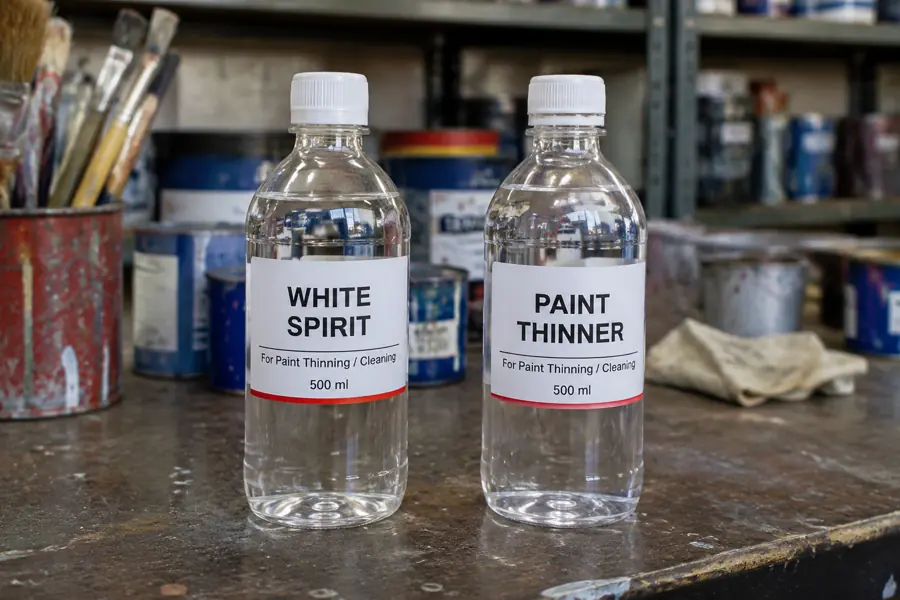
Choosing the right solvent can directly affect paint consistency, drying behavior, surface quality, cleaning efficiency, and overall project cost. For this reason, the White Spirit vs Paint Thinner comparison matters across painting, coatings, construction, automotive, maintenance, and industrial applications.
Although people often use these products for similar purposes, they do not always deliver identical results. Their composition, solvent strength, evaporation rate, odor, compatibility, and application performance can vary significantly. Therefore, professional users should compare them based on the actual job rather than treating the names as interchangeable.
This guide provides a detailed White Spirit vs Paint Thinner comparison and focuses entirely on their practical differences, performance, applications, advantages, limitations, and selection criteria.
White Spirit vs Paint Thinner: Key Differences at a Glance
The main difference between White Spirit vs Paint Thinner comes from consistency of composition. White Spirit generally refers to a more defined petroleum-derived solvent range. In contrast, paint thinner can describe different solvent formulations that manufacturers design for thinning or cleaning.
As a result, two paint thinner products may perform differently even when stores sell them for the same general purpose.
| Comparison Factor | White Spirit | Paint Thinner |
|---|---|---|
| Composition | More standardized petroleum solvent | Can contain different solvent blends |
| Solvent strength | Moderate and controlled | Varies by formulation |
| Evaporation | Usually controlled | Can range from slow to fast |
| Odor | Characteristic solvent odor | Depends on ingredients |
| Paint compatibility | Strong with many oil-based systems | Depends on product formulation |
| Cleaning ability | Reliable for oils and coatings | Can range from moderate to strong |
| Consistency | Generally predictable | May vary between products |
| Industrial suitability | High | Depends on grade |
| Cost | Depends on grade and purity | Often varies widely |
| Best selection method | Specification and application | Formulation and manufacturer guidance |
Therefore, buyers should never select a solvent based only on the product name.
Composition and Consistency
Composition creates one of the most important distinctions in the White Spirit vs Paint Thinner debate.
White Spirit normally offers a relatively consistent hydrocarbon composition within a specified boiling range. Manufacturers can control properties such as aromatic content, flash point, density, and distillation characteristics.
Paint thinner represents a broader commercial category. A manufacturer may formulate it from petroleum solvents or combine several compatible solvents to achieve a particular thinning or cleaning performance.
Consequently, White Spirit often provides greater predictability for industrial buyers who need consistent results between shipments.
Paint thinner can still provide excellent performance. However, users should review its technical specifications before introducing it into a controlled production process.
Solvent Strength
Solvent strength strongly influences how a product interacts with paint, grease, resin, oil, and coating materials.
White Spirit generally provides moderate solvent power. This characteristic makes it useful when users need controlled thinning without creating excessively aggressive action on the coating system.
Paint thinner can provide similar, weaker, or stronger solvent power depending on its formulation.
Therefore, the winner in White Spirit vs Paint Thinner does not depend simply on which product dissolves material faster. Instead, users should select the solvent strength that matches the coating.
An overly strong solvent can affect viscosity, application behavior, drying, or surface appearance. Meanwhile, a weak solvent may fail to reduce viscosity sufficiently.
Controlled performance usually matters more than maximum solvent strength.
White Spirit vs Paint Thinner for Paint Thinning
Paint thinning represents one of the most common reasons buyers compare these two solvents.
White Spirit works particularly well with many oil-based paints, primers, varnishes, and compatible coatings. Its controlled evaporation and solvent action can help users adjust viscosity while maintaining manageable application characteristics.
Paint thinner can also perform this task effectively. However, its performance depends heavily on formulation.
For example, one paint thinner may closely resemble White Spirit, while another may contain a broader solvent blend. Therefore, painters and industrial coating users should always check compatibility with the specific paint system.
When consistency matters across repeated production batches, White Spirit can offer an important advantage.
Evaporation Rate and Working Time
Evaporation rate can change the entire painting process.
A solvent that evaporates too quickly may reduce working time and affect leveling. On the other hand, very slow evaporation may extend drying periods and reduce production speed.
In the White Spirit vs Paint Thinner comparison, White Spirit usually provides relatively predictable evaporation characteristics when buyers purchase a defined grade.
Paint thinner offers less universal predictability because different formulations can use solvents with different boiling ranges.
This difference becomes particularly important in industrial coatings, large painted surfaces, spraying operations, and controlled manufacturing environments.
Users should consider ambient temperature as well. Hot conditions increase evaporation, while colder conditions usually slow it. Therefore, solvent selection should account for both coating requirements and operating conditions.
Effect on Paint Flow and Leveling
Good leveling helps create smooth, professional surfaces.
White Spirit can support controlled paint flow because it reduces viscosity without necessarily evaporating immediately. This characteristic gives the coating more time to spread and level before it begins to set.
Some paint thinners deliver similar results. However, faster formulations can shorten open time.
For brush and roller applications, additional working time can help reduce visible marks. For spray systems, operators may prefer specific evaporation profiles depending on equipment, temperature, coating thickness, and production speed.
Therefore, White Spirit vs Paint Thinner becomes a performance decision rather than simply a price comparison.
Cleaning Performance
Both products can clean painting equipment and remove compatible oily residues.
White Spirit commonly helps clean brushes, rollers, tools, equipment parts, and surfaces contaminated with fresh oil-based coatings. It can also dissolve grease and oily residues in many industrial cleaning operations.
Paint thinner often provides strong cleaning performance as well. Some formulations may act more aggressively, which can help remove stubborn coating residues.
However, stronger action does not always provide an advantage.
An aggressive solvent may affect sensitive plastics, rubber components, existing finishes, adhesives, or coated surfaces. Therefore, users should test compatibility before applying either solvent to sensitive materials.
For routine cleaning that requires predictable action, White Spirit often provides a practical balance between solvency and control.
Odor Differences
Odor also influences purchasing decisions.
Standard White Spirit has a recognizable petroleum-solvent odor. However, suppliers may offer grades with different aromatic contents or odor characteristics.
Paint thinner odor varies considerably because its formulation can differ from one manufacturer to another.
Therefore, comparing White Spirit vs Paint Thinner based only on smell provides limited useful information. Buyers should instead examine composition and product documentation.
For indoor or poorly ventilated operations, users should prioritize suitable workplace controls and follow the product’s safety documentation regardless of perceived odor strength.
Surface Finish and Coating Quality
Solvent selection can influence the final coating appearance.
The correct solvent helps maintain suitable viscosity, promotes flow, supports leveling, and allows the coating to develop the intended finish.
White Spirit’s predictable evaporation profile can help users maintain repeatable results when working with compatible coatings.
A suitable paint thinner can achieve the same objective. However, an unsuitable formulation may change drying behavior or reduce application consistency.
This factor becomes especially important when manufacturers need uniform finishes across large production volumes.
For decorative painting, small variations may create visible brush marks or differences in gloss. For industrial coating operations, inconsistent solvent performance can create production problems and increase rework.
Therefore, buyers should evaluate the solvent as part of the entire coating system.
White Spirit vs Paint Thinner for Industrial Applications
Industrial users usually demand greater consistency than occasional household users.
Manufacturers may use solvents during coating preparation, equipment cleaning, degreasing, formulation, maintenance, or surface preparation. These operations often require predictable specifications.
White Spirit can offer an advantage because industrial buyers can select grades according to technical characteristics such as distillation range, density, flash point, and aromatic content.
Paint thinner may also suit industrial operations when the manufacturer provides a clearly defined specification.
However, buyers should avoid assuming that every general-purpose paint thinner will deliver identical results.
For industrial procurement, technical data should always guide the White Spirit vs Paint Thinner decision.
Application Compatibility
Compatibility represents another major selection factor.
White Spirit commonly suits many oil-based coating systems, alkyd paints, compatible varnishes, primers, and cleaning processes.
Paint thinner compatibility depends on its formulation.
Neither product works universally with every coating. Modern coatings use different resin systems, and each system may require a specific solvent or thinner.
For example, specialized automotive, epoxy, polyurethane, or high-performance coating systems may require manufacturer-approved reducers instead of general-purpose solvents.
Therefore, professional users should follow coating manufacturer recommendations before replacing one solvent with another.
Cost and Consumption
Price often influences bulk purchasing decisions, but the lowest price per liter does not always produce the lowest operating cost.
Users should consider how much solvent the process consumes, how effectively it performs, whether it increases drying time, and whether inconsistent quality creates additional waste.
White Spirit may provide better cost control when an operation values standardized performance and repeatable consumption.
Paint thinner may offer an economical option for general cleaning or less demanding painting jobs. However, formulation differences can affect the amount required to achieve the desired viscosity or cleaning result.
Consequently, businesses should compare total process cost rather than purchase price alone.
Storage and Handling Comparison
Both solvents require responsible storage and handling.
Users should keep containers properly closed and store products in appropriate areas away from incompatible materials, heat, sparks, and ignition sources according to the applicable Safety Data Sheet.
Workers should also use suitable ventilation and appropriate personal protective equipment according to workplace risk assessments.
The exact handling requirements can vary between products because flash point and composition may differ.
Therefore, buyers should review the SDS for the specific grade instead of assuming that White Spirit and every paint thinner share identical handling requirements.
White Spirit vs Paint Thinner for Professional Painters
Professional painters usually value consistency, predictable drying, manageable working time, and reliable cleaning performance.
White Spirit can perform well when painters work with compatible oil-based coatings and need controlled viscosity adjustment.
Paint thinner can also provide a practical option, particularly when the coating manufacturer recommends a specific product.
However, professional users should avoid switching between different paint thinner brands without checking specifications. A formulation change may alter evaporation rate or solvency.
For repeated projects, maintaining a consistent solvent can help painters achieve more predictable application results.
White Spirit vs Paint Thinner for Cleaning Tools
For brushes, rollers, mixing equipment, and other painting tools, both products can perform effectively when the residue remains compatible with petroleum solvents.
White Spirit offers controlled cleaning action and works well for many routine operations.
Paint thinner may provide stronger cleaning action depending on formulation. Therefore, it can prove useful when users need to remove heavier residues.
However, users should not automatically choose the strongest solvent. Strong solvency can damage some synthetic components or finishes.
Instead, choose the mildest solvent that performs the required cleaning effectively.
Which Option Offers Better Consistency?
White Spirit generally provides an advantage when consistency represents the main purchasing requirement.
Industrial buyers can order material against defined technical parameters. This approach makes it easier to maintain stable manufacturing processes.
Paint thinner quality can also remain highly consistent when a reputable manufacturer produces it according to a fixed formulation. However, the general term covers a much wider range of products.
Therefore, businesses that purchase paint thinner should request technical documentation and compare batches against required specifications.
For bulk industrial procurement, White Spirit vs Paint Thinner should always involve technical evaluation rather than name-based selection.
White Spirit Supply for Bulk Buyers
Companies that consume large solvent volumes need more than basic product availability. They need consistent specifications, suitable packaging, reliable logistics, and appropriate technical documentation.
Basekim supplies White Spirit for industrial and commercial requirements and supports bulk buyers that need the product for coatings, cleaning, manufacturing, and related applications.
Before ordering large quantities, buyers should define the required grade, packaging, quantity, destination, and technical parameters. This information helps suppliers provide a more suitable commercial offer.
Advantages of White Spirit Over Paint Thinner
White Spirit can provide several advantages when users require a clearly specified petroleum solvent.
Its controlled composition can improve consistency between batches. Moreover, predictable evaporation helps users manage working time and coating behavior.
Industrial buyers can also compare technical parameters more easily when purchasing a defined White Spirit grade.
However, these advantages do not make White Spirit automatically better for every application. A specialized paint thinner may outperform it when a coating manufacturer designs that thinner for a specific paint system.
Advantages of Paint Thinner Over White Spirit
Paint thinner offers flexibility.
Manufacturers can formulate it for specific coating, cleaning, or application requirements. Therefore, users can sometimes find a paint thinner that delivers exactly the evaporation or solvency profile they need.
General-purpose paint thinner can also provide a cost-effective choice for routine cleaning and basic painting operations.
However, this flexibility creates variation. Buyers must check the formulation rather than assuming that every paint thinner provides the same properties.
How to Choose Between White Spirit and Paint Thinner
The best choice depends on the application.
Choose based on coating compatibility, required solvent power, evaporation rate, application method, working temperature, surface sensitivity, cleaning requirements, safety documentation, and overall process cost.
For repeated industrial processes, consistency should receive high priority. In contrast, general maintenance operations may place greater importance on cost and cleaning power.
Painters should also consider application technique. Brush, roller, and spray systems can respond differently to changes in solvent evaporation.
Most importantly, users should follow the coating manufacturer’s recommended thinning ratios and solvent requirements.
White Spirit vs Paint Thinner: Which Is Better?
There is no universal winner in the White Spirit vs Paint Thinner comparison.
White Spirit often makes more sense when users want predictable composition, moderate solvency, controlled evaporation, and reliable performance with compatible oil-based coatings.
Paint thinner can make more sense when users need a formulation specifically designed for a particular paint, cleaning operation, or working condition.
Therefore, the application should determine the choice.
Industrial users should compare technical specifications. Professional painters should prioritize coating compatibility and finish quality. Maintenance teams should focus on cleaning effectiveness and material compatibility.
Final Comparison
The White Spirit vs Paint Thinner comparison shows why buyers should look beyond product names.
White Spirit generally offers greater compositional consistency and predictable performance. Paint thinner covers a wider range of formulations and can provide different levels of solvent strength and evaporation speed.
For painting, the correct choice can improve viscosity control, leveling, working time, and final appearance. For cleaning, it can improve residue removal while reducing the risk of damaging sensitive materials. Meanwhile, for industrial applications, consistent specifications can support better process control.
Ultimately, choose White Spirit when you need a defined, predictable petroleum solvent for compatible applications. Choose paint thinner when a particular formulation better matches the coating or cleaning requirement.
By evaluating composition, solvent strength, evaporation, compatibility, safety requirements, and total operating cost, buyers can make a much stronger White Spirit vs Paint Thinner purchasing decision.