
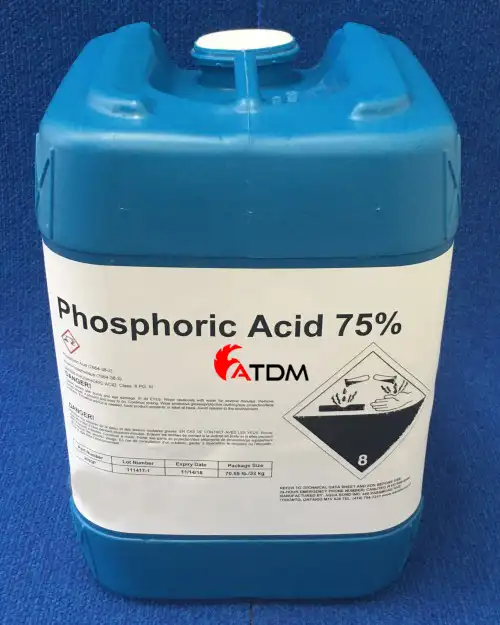
Phosphoric Acid is an important inorganic acid that serves fertilizer, food, beverage, water treatment, metal processing, detergent, and chemical manufacturing industries. Manufacturers value this versatile chemical because it provides controlled acidity, high solubility in water, and reliable performance across many industrial processes.
The chemical formula of phosphoric acid is H₃PO₄. Commercial suppliers usually offer it as a clear, colorless liquid in different concentration levels and purity grades. Among them, 85% phosphoric acid remains one of the most common commercial grades.
Industrial buyers should select a suitable grade according to purity, concentration, application, packaging, and regulatory requirements.
ATDM supplies and exports Phosphoric Acid for industrial and commercial customers and supports international B2B orders with suitable packaging and technical documentation.
Chemical Properties and Characteristics
Phosphoric acid belongs to the group of mineral acids. Unlike some stronger mineral acids, it provides controlled acidity while still supporting many chemical reactions and manufacturing processes.
It dissolves readily in water. Furthermore, manufacturers can use different concentrations according to the needs of their production lines.
Typical general properties include:
| Property | Typical Information |
|---|---|
| Chemical Name | Phosphoric Acid |
| Chemical Formula | H₃PO₄ |
| CAS Number | 7664-38-2 |
| Molecular Weight | 98.00 g/mol |
| Appearance | Clear, colorless liquid |
| Odor | Nearly odorless |
| Solubility | Completely miscible with water |
| Common Concentration | 75–85% |
| Common Commercial Grade | 85% |
| Chemical Type | Inorganic mineral acid |
Exact specifications may vary according to grade and production method. Therefore, buyers should review the Technical Data Sheet and Certificate of Analysis before confirming an order.
Common Grades of Phosphoric Acid
Different industries require different purity levels. For this reason, suppliers normally classify the product according to application and quality.
Industrial Grade
Industrial-grade phosphoric acid serves fertilizer production, metal treatment, detergents, water treatment, chemical manufacturing, and various processing industries.
This grade offers a practical balance between technical performance and commercial cost.
Food Grade
Food-grade material requires stricter impurity control and compliance with applicable food-processing requirements.
Food and beverage manufacturers use food-grade phosphoric acid as an acidulant, acidity regulator, and processing ingredient in approved applications.
Technical Grade
Technical-grade material supports general chemical processing, surface treatment, cleaning formulations, and other industrial operations.
However, buyers should always verify whether the technical specification matches their intended application.
85% Phosphoric Acid
Phosphoric Acid 85% represents one of the most widely traded concentrations in international chemical markets.
Manufacturers prefer this concentration because it offers high active acid content while remaining suitable for storage, transportation, dilution, and industrial processing.
The product normally appears as a clear, viscous, colorless liquid.
Industries can dilute the 85% solution according to their production requirements. As a result, this concentration provides flexibility for manufacturers that operate different processing lines.
Major Industrial Applications
The broad application range creates strong global demand for phosphoric acid.
Fertilizer Production
The fertilizer industry represents one of the largest consumers.
Manufacturers use phosphoric acid as a major raw material in the production of phosphate fertilizers. It supports the manufacture of products that supply phosphorus, an essential plant nutrient.
Therefore, agricultural demand strongly influences the global phosphoric acid market.
Food and Beverage Industry
Food-grade material serves several food-processing applications.
Manufacturers may use it as an acidity regulator or acidulant in approved formulations. Beverage manufacturers also use carefully controlled quantities in certain drinks.
In addition, food processors may use phosphates derived from this acid in various manufacturing processes.
However, manufacturers must use the correct food-grade specification and comply with applicable regulations.
Metal Surface Treatment
Metal-processing companies use phosphoric acid in cleaning and surface-preparation systems.
It can help remove oxide layers and prepare metal surfaces before coating, painting, or other finishing processes.
Additionally, phosphate-based treatment processes can improve surface preparation in selected industrial applications.
Water Treatment
Water-treatment companies use phosphate chemistry in different treatment programs.
Depending on the system design, phosphoric-acid-based products may support pH adjustment and other industrial water-treatment processes.
Operators must carefully control concentration and dosage to achieve consistent results.
Detergent and Cleaning Products
Chemical manufacturers use phosphoric acid in selected industrial cleaning and detergent formulations.
Its acidic properties help support mineral deposit removal and surface-cleaning processes.
However, formulators must evaluate compatibility with surfaces and other ingredients before using the chemical.
Chemical Manufacturing
Chemical producers use H₃PO₄ as a raw material for producing different phosphate compounds.
These compounds support agriculture, food processing, water treatment, cleaning products, ceramics, and other industries.
Consequently, phosphoric acid plays an important role throughout the chemical supply chain.
Benefits for Industrial Users
The product offers several advantages for manufacturers.
First, its high water solubility makes dilution and formulation easier. Furthermore, manufacturers can purchase different concentration levels according to their technical requirements.
It also supports a wide range of chemical reactions and production systems.
Other benefits include:
Wide industrial application range
Easy dilution with water
Stable commercial availability
Multiple purity grades
Strong role in phosphate production
Suitable use in controlled acidity applications
Availability for bulk B2B supply
These characteristics make it an important raw material for many international industries.
Quality and Purity
Quality requirements depend heavily on the final application.
A fertilizer manufacturer may accept specifications that differ significantly from those required by a food producer.
Therefore, buyers should evaluate several parameters before purchasing.
Important parameters can include:
H₃PO₄ assay
Concentration
Appearance
Density
Iron content
Chloride
Sulfate
Heavy metals
Fluoride
Color
Arsenic level where applicable
Customers should request a Certificate of Analysis (COA) to verify the specifications of a particular batch.
Phosphoric Acid Price
The Phosphoric Acid price changes according to raw material costs, concentration, purity, market demand, packaging, shipping conditions, and destination.
For example, food-grade material may carry a different price from general industrial-grade material because producers must meet stricter quality requirements.
Order volume also affects commercial pricing.
Bulk orders generally involve a different cost structure than smaller packaged shipments.
For an accurate quotation, buyers should provide:
Required grade
Required concentration
Quantity
Packaging preference
Destination port
Incoterm
Required documentation
ATDM can evaluate these details and provide a quotation according to current market conditions.
Packaging Options
Proper packaging protects product quality and supports safe transportation.
Depending on the order size and destination, phosphoric acid may ship in suitable:
HDPE drums
IBC tanks
Chemical-resistant containers
ISO tanks
Bulk tankers
Packaging must remain compatible with the selected acid concentration.
Additionally, export shipments must follow applicable transport and destination regulations.
ATDM can coordinate packaging options according to customer requirements, order volume, and shipment conditions.
Storage and Handling
Store the material in a cool, dry, and well-ventilated location.
Keep containers tightly closed when workers do not use them. Furthermore, protect packaging from physical damage and excessive heat.
Operators should avoid contact with incompatible materials, especially strong bases and reactive metals.
Workers should use suitable personal protective equipment, including:
Chemical-resistant gloves
Safety goggles
Protective clothing
Face protection where required
Suitable footwear
Facilities should also provide appropriate ventilation and emergency washing equipment.
Always follow the current supplier-issued Safety Data Sheet when designing storage and handling procedures.
Transportation
Phosphoric acid requires controlled transportation because concentrated solutions can cause severe corrosion and chemical burns.
Shippers must use suitable containers, labels, transport documents, and handling procedures.
Transportation requirements depend on product concentration, shipment quantity, transport method, and destination regulations.
Therefore, international buyers should work with experienced chemical exporters and logistics providers.
Technical Documentation
Professional B2B customers often require complete documentation before approving a shipment.
Depending on the order, ATDM can provide relevant documents such as:
Technical Data Sheet (TDS)
Safety Data Sheet (SDS/MSDS)
Certificate of Analysis (COA)
Commercial Invoice
Packing List
Certificate of Origin where applicable
Shipping documentation
These documents help purchasing teams evaluate product quality and manage import procedures.
Choosing a Reliable Phosphoric Acid Supplier
Price alone should not determine supplier selection.
Industrial buyers should also consider product quality, concentration consistency, technical documentation, packaging, shipment capability, and communication.
A dependable Phosphoric Acid supplier should clearly identify the grade and specifications before shipment.
Moreover, professional exporters should coordinate packaging and international logistics according to the destination market.
ATDM Phosphoric Acid Supplier
ATDM acts as a supplier and exporter of Phosphoric Acid for international B2B customers.
Customers can request industrial or other available grades according to their technical requirements.
ATDM supports buyers with product specifications, commercial quotations, export packaging, and relevant documentation based on the confirmed order.
Frequently Asked Questions
What is the most common concentration?
85% phosphoric acid represents one of the most common commercial concentrations. Other concentrations may also be available depending on the application.
Which industries use H₃PO₄?
Fertilizer, food and beverage, chemical, metal treatment, water treatment, detergent, and industrial manufacturing sectors commonly use it.
Is food-grade material different from industrial grade?
Yes. Food-grade products require tighter impurity limits and must meet relevant food-industry requirements.
How should buyers select the right grade?
Buyers should consider concentration, purity, application, impurity limits, regulatory requirements, packaging, and destination.
Does ATDM supply Phosphoric Acid?
Yes. ATDM supplies and exports Phosphoric Acid for industrial and commercial B2B customers and can provide specifications and commercial offers according to order requirements.
Order Phosphoric Acid from ATDM
Industrial buyers should provide complete technical and commercial requirements before requesting a quotation.
Specify the desired grade, concentration, quantity, packaging method, destination, and delivery terms.
ATDM supplies Phosphoric Acid for international markets and supports B2B customers with suitable packaging, technical documentation, and export coordination.
Contact ATDM with your required specification to receive current product information and a commercial quotation.