Description of PAC Polyanionic Cellulose
PAC LV Polyanionic Cellulose a substance that can be added to drilling muds, depending on the intended application and desired properties of the mud includes detergents, foaming agents, and deforming agents.
Having fluid-loss control, shale inhibition, and salt tolerance. It is useful for water-based drilling fluids as well as in low-density brines, for one or a lot of functions.
Usages of PAC LV Polyanionic Cellulose
Our special PAC LV is characterized by such behavior in solution as allows reduction of the fluid loss with relation to the bottom fluid while not the soluble polymer. Also, Water soluble polymers particularly the most popular are referred to as polymers and have varied substitution degrees and molecular weight.
The behavior and result of these viscosities in an exceeding lubricator typically depend upon the scale of the polymer’s molecules and their charge (e.g., anionic, cationic, or non-ionic).
The PAC LV Polyanionic cellulose is additionally a Fluid loss reducer that could be used in a mud-in step with this invention if desired. Some common fluid loss reducers embrace, for instance, starches or CMC, and a number of these chemicals may have a viscosities perform. This excellent loss reducer could give steric stabilization for the non-ionic Surfactants.
Both water and organic solvents will function as the basis for drilling fluids, but today’s environmental protection needs and technological options of well processes verify the employment of water-based drilling fluids in most cases.
Given that PAC, being a soluble polymer, serves as an additive that enhances performance.
In conclusion most known features of this property are below.
– Due to its film-forming functions, it slows down the erosion of the walls of the well, preventing it from falling asleep.
– Improves the cooling and lubricating
– Contributes to the upkeep of the thermal and biological stability of mud.
Packing the product
The product is packed in 25kg or 50lb net multiply paper bags or valve paper bags. These should be stored in a cool, dry place.
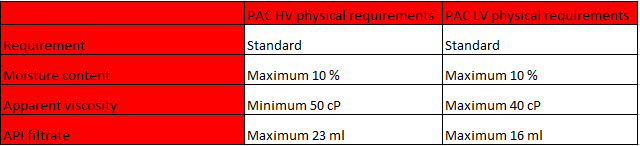
Specification of PAC LV HV