
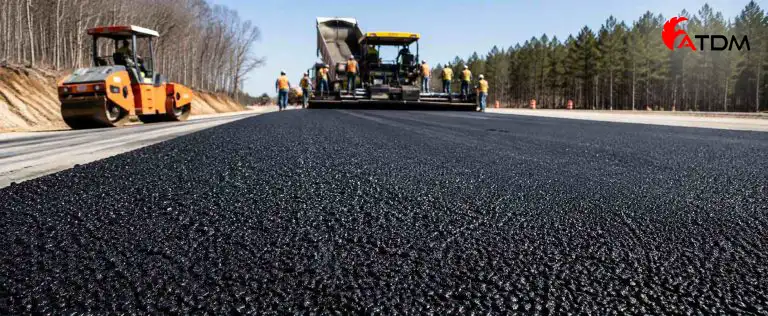
How much bitumen do you need to construct one kilometer of road? The answer depends on pavement width, asphalt thickness, mixture density, and binder content. For a typical 1 km road measuring 7 meters wide with a 50 mm asphalt layer, contractors need approximately 42 tonnes of pure bitumen, assuming a 5% binder content and compacted asphalt density of 2.4 tonnes per cubic meter.
Accurately estimating bitumen quantity for road construction helps contractors reduce material waste, prepare reliable project budgets, and organize asphalt deliveries. However, every project has different engineering requirements. Highways, urban streets, industrial roads, and residential pavements may require different pavement structures and asphalt mixtures.
This guide explains the calculation process, material consumption per square meter, suitable paving grades, and practical procurement considerations for road construction projects.
Bitumen Quantity for Road Construction: 1 km Estimate
The amount of paving binder required for one kilometer depends primarily on the total asphalt mixture weight and its binder percentage.
Conventional hot mix asphalt commonly contains approximately 4–6% bitumen by total mixture weight. Engineers determine the final percentage through an approved laboratory mix design.
Consider a standard two-lane road with the following specifications:
| Parameter | Project Specification |
|---|---|
| Road Length | 1,000 meters |
| Road Width | 7 meters |
| Asphalt Layer Thickness | 50 mm |
| Compacted Asphalt Density | 2,400 kg/m³ |
| Bitumen Content | 5% |
| Total Asphalt Mixture | 840 tonnes |
| Pure Bitumen Required | 42 tonnes |
Under these conditions, contractors need approximately 42 tonnes of pure binder for one asphalt layer.
This estimate excludes additional pavement layers, prime coats, tack coats, road shoulders, and construction allowances.
For a multilayer highway, engineers must calculate each asphalt course separately to determine the total material requirement.
How to Calculate Bitumen Quantity for Road Construction
Engineers use a straightforward mathematical method to estimate binder requirements. The calculation begins with pavement dimensions and ends with the total weight of pure bitumen.
Step 1: Calculate Road Surface Area
Multiply road length by paved width.
Road Area (m²) = Length (m) × Width (m)
For a 1,000-meter road measuring 7 meters wide:
1,000 × 7 = 7,000 m²
The road covers 7,000 square meters.
Step 2: Calculate Asphalt Volume
Multiply the paved area by the compacted asphalt thickness.
Asphalt Volume (m³) = Area (m²) × Thickness (m)
Convert 50 mm into meters:
50 ÷ 1,000 = 0.05 m
Then calculate:
7,000 × 0.05 = 350 m³
The pavement requires 350 cubic meters of compacted asphalt.
Step 3: Calculate Total Asphalt Mixture Weight
Multiply the compacted asphalt volume by the mixture density.
Asphalt Weight (tonnes) = Volume (m³) × Density (t/m³)
350 × 2.4 = 840 tonnes
The project requires approximately 840 tonnes of asphalt mixture.
Step 4: Calculate Pure Bitumen Consumption
Multiply the asphalt mixture weight by the binder percentage.
Bitumen Required (tonnes) = Asphalt Weight × Binder Content ÷ 100
840 × 5 ÷ 100 = 42 tonnes
The final estimate equals 42 tonnes of pure bitumen.
This method assumes that the binder percentage refers to the total asphalt mixture mass. If a project specification expresses binder content relative to dry aggregate mass, engineers must adjust the calculation.
Bitumen Requirement for Different Road Widths
Road width significantly affects total asphalt consumption. A wider road requires more material even when contractors use the same layer thickness and mixture design.
The following table estimates bitumen consumption for one kilometer of road using a 50 mm asphalt layer, 2.4 t/m³ compacted density, and 5% binder content.
| Road Width | Asphalt Mixture | Bitumen Required |
|---|---|---|
| 3.5 meters | 420 tonnes | 21 tonnes |
| 5 meters | 600 tonnes | 30 tonnes |
| 6 meters | 720 tonnes | 36 tonnes |
| 7 meters | 840 tonnes | 42 tonnes |
| 8 meters | 960 tonnes | 48 tonnes |
| 10 meters | 1,200 tonnes | 60 tonnes |
| 12 meters | 1,440 tonnes | 72 tonnes |
These values provide preliminary estimates for contractors and procurement teams.
However, actual requirements may increase when projects include intersections, additional lanes, access roads, or variable pavement thicknesses.
For accurate purchasing decisions, contractors should calculate each paved section separately.
How Thickness Affects Bitumen Quantity for Road Construction
Asphalt thickness directly influences total material requirements. Engineers select pavement thickness according to traffic loads, pavement structure, subgrade conditions, and expected service life.
A thin surface layer requires less asphalt than a thick structural course covering the same area.
The following table illustrates the relationship between thickness and binder consumption for a 7-meter-wide, 1 km road.
| Asphalt Thickness | Asphalt Weight | Pure Bitumen |
|---|---|---|
| 30 mm | 504 tonnes | 25.2 tonnes |
| 40 mm | 672 tonnes | 33.6 tonnes |
| 50 mm | 840 tonnes | 42 tonnes |
| 60 mm | 1,008 tonnes | 50.4 tonnes |
| 75 mm | 1,260 tonnes | 63 tonnes |
| 100 mm | 1,680 tonnes | 84 tonnes |
| 150 mm | 2,520 tonnes | 126 tonnes |
All calculations assume a compacted density of 2.4 t/m³ and a 5% binder percentage.
Actual pavement layers may contain different binder percentages. Engineers should use the approved mixture design for each course rather than applying one percentage to the entire pavement structure.
How Much Bitumen Is Required Per Square Meter?
Contractors frequently calculate bitumen consumption per square meter when estimating parking areas, industrial yards, residential streets, and smaller paving projects.
The calculation uses three values: compacted asphalt thickness, mixture density, and binder percentage.
Bitumen (kg/m²) = Thickness (m) × Density (kg/m³) × Binder Fraction
For a 50 mm asphalt layer:
0.05 × 2,400 × 0.05 = 6 kg/m²
Therefore, one square meter requires approximately 6 kg of pure binder under these assumptions.
| Asphalt Thickness | Bitumen per m² |
|---|---|
| 30 mm | 3.6 kg |
| 40 mm | 4.8 kg |
| 50 mm | 6.0 kg |
| 60 mm | 7.2 kg |
| 75 mm | 9.0 kg |
| 100 mm | 12.0 kg |
These values represent the binder contained inside compacted asphalt mixtures. They do not represent the application rates for prime coats, tack coats, or surface treatments.
What Percentage of Bitumen Is Used in Asphalt?
The optimum binder percentage depends on aggregate characteristics, mixture design, and expected pavement performance.
Conventional dense-graded asphalt mixtures commonly contain approximately 4–6% bitumen by total weight.
However, specialized mixtures may require different percentages.
Engineers consider several technical parameters when selecting binder content:
Aggregate gradation and particle shape
Aggregate absorption and surface texture
Air void content and volumetric properties
Binder viscosity and temperature characteristics
Traffic loading and pavement performance requirements
Moisture susceptibility and durability
Using insufficient binder can increase the risk of cracking, raveling, and reduced pavement durability.
Excessive binder may contribute to bleeding, rutting, and deformation under heavy traffic.
Laboratory mix design helps engineers balance durability, workability, and resistance to pavement distress.
Choosing the Right Bitumen Grade for Road Construction
Material quantity alone does not guarantee pavement performance. Contractors must also select the appropriate binder grade according to local specifications, climate conditions, and traffic requirements.
Bitumen 60/70
Penetration grade 60/70 is a commonly specified paving binder in international road construction markets.
It provides penetration characteristics within the 60–70 range under standardized testing conditions.
Engineers use this grade in suitable asphalt mixtures where the pavement design and climate requirements support its selection.
Bitumen 80/100
This penetration grade generally has a softer consistency than 60/70.
Contractors may use it in applications requiring a softer paving binder, depending on the approved specification.
Viscosity Grade VG30
VG30 belongs to the viscosity grading system used in certain road construction markets.
Its classification relies on standardized viscosity and related physical-property requirements.
Performance Grade Bitumen
Performance-graded binders use temperature-based classifications.
Engineers select appropriate PG grades according to pavement temperature, traffic loading, and relevant specifications.
The selected binder grade influences pavement performance, but the approved asphalt mix design determines the final binder content.
Key Factors Affecting Bitumen Quantity for Road Construction
Several technical variables influence the final quantity required for a road project.
Traffic Volume and Heavy Vehicle Loads
Roads carrying heavy commercial vehicles often require more demanding pavement designs than lightly trafficked residential streets.
Engineers may specify thicker asphalt structures, modified binders, or specialized mixtures to improve resistance to deformation and fatigue.
Aggregate Quality
Aggregate absorption affects the amount of binder available within the asphalt mixture.
Porous aggregates may absorb more binder, while dense aggregates may require different optimum binder contents.
Aggregate gradation and surface texture also influence mixture performance.
Climate Conditions
High pavement temperatures increase the importance of rutting resistance.
Low temperatures increase the importance of cracking resistance.
Climate primarily affects binder selection and mixture design rather than establishing a fixed material consumption rate.
Asphalt Mixture Type
Dense-graded asphalt, stone mastic asphalt, and open-graded mixtures have different aggregate structures and binder requirements.
Contractors should not apply the same binder percentage to every mixture type.
Compacted Asphalt Density
Mixture density determines the total mass of asphalt within a specific pavement volume.
An inaccurate density assumption can produce substantial errors in material estimates, particularly on large highway projects.
Construction Accuracy
Uneven pavement surfaces, inconsistent paving thickness, rejected materials, and handling losses can increase procurement requirements.
Accurate surveying and construction controls help contractors reduce these differences.
Calculating bitumen quantity for Multilayer Road Pavements
A complete asphalt pavement may contain a wearing course, binder course, and asphalt base course.
Each layer performs a different structural function and may use a different binder percentage.
Consider a 1 km road measuring 7 meters wide.
| Asphalt Layer | Thickness | Binder Content | Bitumen Quantity |
|---|---|---|---|
| Wearing Course | 40 mm | 5.5% | 36.96 tonnes |
| Binder Course | 60 mm | 4.5% | 45.36 tonnes |
| Asphalt Base Course | 100 mm | 4.0% | 67.20 tonnes |
| Total | 200 mm | — | 149.52 tonnes |
The calculation assumes a compacted asphalt density of 2.4 t/m³ for every layer.
The complete asphalt structure therefore requires approximately 149.52 tonnes of pure binder before additional allowances.
This method gives contractors a more realistic procurement estimate than calculating only the surface layer.
Do Prime Coat and Tack Coat Increase Bitumen Consumption?
Road projects may require additional bituminous materials for surface preparation and bonding.
Contractors should calculate these treatments separately from the binder contained inside asphalt mixtures.
Prime Coat
A prime coat treats a suitable prepared granular surface before subsequent pavement construction.
Depending on project specifications, contractors may use approved bitumen emulsions or cutback materials.
Application rates depend on surface porosity, material properties, and construction requirements.
Tack Coat
A tack coat improves bonding between pavement layers.
Contractors commonly apply bitumen emulsions at rates specified by the project engineer.
For example, a road covering 7,000 m² with a specified residual binder rate of 0.30 kg/m² requires:
7,000 × 0.30 = 2,100 kg
That equals 2.1 tonnes of residual binder.
If the selected emulsion contains 60% residual binder by mass, the theoretical emulsion requirement equals:
2.1 ÷ 0.60 = 3.5 tonnes
Contractors must distinguish between the weight of delivered emulsion and the amount of residual bitumen it contains.
How to Reduce Bitumen Waste During Road Construction
Accurate material planning helps contractors control project expenses without compromising pavement quality.
Construction teams should begin with an approved asphalt mix design and verified pavement dimensions.
They should also monitor binder dosing, aggregate moisture, asphalt production temperatures, and paving thickness.
Modern asphalt plants use automated systems to control mixture proportions and reduce production variability.
Digital surveying and paving controls can help maintain consistent layer thickness.
Proper transportation scheduling also reduces unnecessary delays and material rejection.
Contractors should never reduce binder content below the approved mixture design simply to lower purchasing costs. Doing so may compromise pavement durability and increase long-term maintenance expenses.
How Much Does Bitumen Cost for 1 km of Road?
The cost of paving binder depends on the required quantity, selected grade, delivery location, packaging, and prevailing market conditions.
Consider a road requiring 42 tonnes of pure bitumen.
The following table presents hypothetical budgeting scenarios rather than current market quotations.
| Assumed Price per Tonne | Estimated Binder Cost |
|---|---|
| $350 | $14,700 |
| $400 | $16,800 |
| $450 | $18,900 |
| $500 | $21,000 |
| $550 | $23,100 |
These figures exclude aggregate materials, asphalt production, transportation, labor, equipment, and construction expenses.
Buyers can review bitumen pricing information when preparing project budgets.
International quotations may vary according to shipment volume, destination, packaging requirements, and commercial delivery terms.
Commercial Bitumen Supply for Highway and Infrastructure Projects
Large road construction projects require consistent material quality, reliable logistics, and accurate purchasing schedules.
Procurement managers should determine the required binder grade, total quantity, delivery frequency, and storage requirements before ordering.
Bulk bitumen delivery may offer an efficient solution for projects equipped with suitable heated storage and unloading facilities.
Steel drums can provide additional flexibility for smaller projects or destinations without dedicated bulk infrastructure.
Other approved packaging systems may support specific international shipping requirements.
ATDM supplies paving bitumen for road construction and infrastructure projects, with commercial supply options for international buyers, contractors, and distributors.
Purchasing teams should request technical specifications, certificates of analysis, available packaging details, and quotations before confirming an order.
Conclusion: bitumen quantity for road construction
Accurate bitumen quantity for road construction calculations help contractors estimate material demand, prepare budgets, and coordinate supply schedules.
For a 1 km road measuring 7 meters wide with a 50 mm asphalt layer, a compacted density of 2.4 t/m³, and 5% binder content, the estimated requirement equals 42 tonnes of pure bitumen.
However, wider roads, thicker pavement structures, and additional asphalt layers increase total consumption.
Engineers should calculate each layer separately and verify all estimates against the approved pavement design and laboratory mix formula.
Reliable calculations and coordinated procurement help road construction teams reduce waste, manage project costs, and maintain consistent pavement quality.
Frequently Asked Questions (FAQ)
1. How much bitumen is required for 1 km of road?
A 1 km road measuring 7 meters wide with a 50 mm asphalt layer requires approximately 42 tonnes of pure binder when the mixture contains 5% bitumen and has a compacted density of 2.4 t/m³.
2. What is the formula for calculating bitumen quantity?
Multiply road length by width and compacted asphalt thickness. Then multiply the resulting volume by mixture density and the binder percentage expressed as a decimal.
3. How much bitumen is needed for 100 square meters?
A 100 m² surface with a 50 mm asphalt layer, 2,400 kg/m³ compacted density, and 5% binder content requires approximately 600 kg of pure bitumen.
4. What percentage of bitumen is used in road asphalt?
Conventional dense-graded asphalt mixtures commonly contain approximately 4–6% bitumen by total mixture weight. The approved mix design determines the exact percentage.
5. How much asphalt is required for 1 km of road?
A 1 km road measuring 7 meters wide with a 50 mm asphalt layer requires approximately 840 tonnes of compacted asphalt mixture at a density of 2.4 t/m³.
6. Which bitumen grade is suitable for highway construction?
Common paving grades include penetration grades 60/70 and 80/100, viscosity grades such as VG30, and performance-graded binders. Engineers select the appropriate grade according to climate, traffic, and project specifications.